---
title: "Selling Without Convincing"
author: "Josh Braun"
url: "https://books.joshbraun.com/4/forsale"
---
**INTRODUCTION**
The other day, I walked into Hugo Boss.
Three steps in: “Can I help you?”
Without thinking: “No thanks, just looking.”
But I wasn’t just looking.
Nobody drives to a department store for fun.
That reflexive brush-off?
It’s what I call the Zone of Resistance.
The shield people raise the moment they sense sales pressure.
And as sellers, we trigger it all the time.
Pushing.
Convincing.
Persuading.
Begging for 27 seconds.
Leading people into a “yes trap”:
“If I could save you 20% on socks, would you be interested?”
Or the classic:
“I’d love to show you the belts that go perfectly with those pants.”
The customer silently thinks, Of course you’d love to.
You want a sale. You’re biased.
They can smell the commission breath.
But imagine this instead:
I walk into Hugo Boss and the salesperson gently and calmly says,
“Business trip?”
I would have said,
“Actually no, I’ve got a wedding coming up.”
Now we're having a conversations.
It's called elicitation.
Elicitation is the art of getting someone to share information without feeling questioned.
Gentle prompts that invite people to volunteer the truth on their own.
It works because people have a natural urge to correct or confirm what they believe isn’t quite accurate. When you offer a gentle prompt, they step in to “set the record straight.”
Intelligence agencies use it.
Therapists use it.
Pro sellers use it.
It works the same in cold calling.
Say you’re selling a self-cleaning coffee machine. Instead of pitching, Try this:
“Coffee machines have tiny spots, especially around the spout and drip tray, where bacteria like E. coli and staph can grow. How do you usually keep yours clean?"
See what happened?
You poked the bear.
You illuminated a potential problem they may not be thinking about.
They pause.
They think.
Curiosity kicks in.
They think, Huh… good question.
They lean in.
The best way to persuade people is let them persuade themselves.
If you want to be a better closer, be a better opener.
This book shows you how.
**ADOPT A SURFER’S MIND**
I’m watching surfers in Bolinas, California.
Surfers don’t care if they wipe out.
They don’t feel “rejected” by a wave.
Wiping out is the nature of surfing.
When surfers wipe out, they paddle out, wait for a wave, and begin again.
Surfers don’t judge waves.
Surfers don’t have expectations.
Surfers aren’t attached to the outcome.
Some waves last longer than others.
Big and small waves are part of the same experience.
Surfing just is.
It’s the same with selling.
Some conversations last a long time and turn into business.
Some fizzle out.
“Good” and “bad” conversations are part of the same experience.
Paddle out (identify prospects).
Wait for the wave (reach out).
Surf (have a conversation).
“Waves” come and go all the time.
Accept each “wave” or conversation without judgment.
Let go of expectations.
Detach from the outcome.
Hang loose.
Adopt a surfer’s mind.
**NEGATIVITY**
Can I dump garbage in your yard?
Of course not.
That would be insane.
Yet every day, people dump garbage into our minds:
“This job sucks. We don’t get enough training!”
“They shrunk my territory!”
“These leads are terrible.”
“Bob missed his numbers again. He’s not going to last, right?”
The problem?
Listen to negativity long enough, and you become negative too.
Exposure to prolonged negativity peels away neurons in the brain’s hippocampus—the part of the brain you need to think critically.
In other words, too much negativity makes you dumb.
The way out?
The next time someone dumps garbage into your brain, don’t add fuel to the fire. Extinguish the flame instead. Like this:
“This job sucks. We don’t get enough training.”
“Mmm.”
“They shrunk my territory!”
“They did.”
“Our quota keeps going up.”
“It does.”
“I’m not getting any leads from marketing.”
“So what are you going to do about it?”
“There’s so much f**king traffic!”
“There is.”
“Bob missed his numbers. He’s not going to last, right?”
“I’m not sure.”
“You’re so slow.”
“I am.”
“I hate it here. I regret going into sales.”
“Okay.”
“What do you think you’ll do?”
“These leads are terrible.”
(Silence).
Silence speaks louder than words.
Leave people wondering why you're conserving energy rather than spending energy piling on more negative.
The golden rule?
If you hang out with someone and feel the positive energy getting zapped out of your body, it's a signal to spend less time with them.
A surfer in Bolinas, California.
**NO FORMULAS**
Let's get this out of the way right now.
There is no “formula” for being successful in sales.
By formula, I mean, “If you do X, Y, and/or Z, then you will be successful."
However, there are a few guiding principles you can adopt that will help you get better.
Have no expectations. Your grass-fed beef is for some people, but it’s not for everyone. It’s not your job to talk vegans into being meat eaters. Find meat eaters. There are lots of them.
**We’re all under construction**. Don’t let a mistake ruin your day. Each day has four quarters – morning, mid-morning, afternoon, and evening. Messed up in Q1? That’s okay—kick rocks for 5 minutes. Then, begin again in Q2.
**Detach from the outcome**. Tune out what you don’t control. Focusing on things you don’t control is a recipe for being angry and pissed off all the time. You don’t control when or if people buy. Water flowers. Provide sunlight. Flowers don’t grow faster because it’s the end of the quarter.
**Be honest all the time**. If you’re honest sometimes, you’re not honest all the time. Integrity is at the heart of selling.
**Be patient**. Most people don’t fail at selling. They’re just not patient enough. It takes three years of deliberate practice to master any money-making skill.
**Don’t compare yourself to others**. The only rep you should try to beat is the rep you were yesterday.
**Everything’s going to be okay**. Sales and life have ups and downs. Neither lasts forever. Time heals all downs.
**No convincing**. It’s not your job to talk people into buying. Whenever prospects feel sales pressure, they enter the Zone of Resistance. Instead, illuminate problems prospects might not be aware of and let them make up their own mind. In other words, poke the bear.
**Slow down**. Read the email twice before sending it. Rushing = careless mistakes.
**Rewire your brain to listen**. People don’t buy because they understand you. They buy because you understand them. Knowing how to make people feel heard and understood is a superpower for getting through to anyone in your personal or business life. You can *gasp* understand people without agreeing with them.
**WHAT WORKS**
I’m often asked:
“How do I know what works?”
The question implies that you only want to do what works.
But you don’t know what works :-)
What works isn’t a formula.
You won’t find it in a book.
Or on a podcast about how to unleash your potential.
Success is a process of becoming.
A few months ago, piano hand indepedence felt impossible.
Today, it’s easier.
I wasn't failing. I was becoming better.
Do what you want.
Do things that don’t work.
Do tiny experiments.
Observe.
Be conscious.
Be patient.
If you pay attention, “what works” unfolds naturally.
There is no receipt that suits all cases.
**THE GET**
Most salespeople are focused on the get.
Get a meeting.
Get a sale.
Get a referral.
Get a reply.
Get around a gatekeeper.
Get to a decision maker.
Get someone to change their mind.
It’s about the withdrawal.
The take.
Prospects can feel taking energy.
So can you.
So can everyone.
Taking never felt good on my soul.
What’s felt better in my soul is to have a giver mindset.
To make a deposit.
To detach from the outcome.
Giving without expecting anything in return emits a completely different energy.
How do you emit a giving energy?
Every time I have a conversation with a prospect I secretly repeat my mantra:
“It's not my job to get what I want.
My job is to illuminate a potential problem.
Some people will be interested in talking further. Others won't. My role is to be humbly curious and listen without having expectations.”
Why does this matter?
When you're a taker, people enter the Zone of Resistance (ZOR) because they can smell your commission breath.
The ZOR is a shield against self-serving takers.
When you give, prospects are more likely to lower their shield because they don't feel the take.
**IT HAPPENS**
Marty’s been fly fishing three months a year for 50 years.
This year he took me with him.
While changing a fly, the wind kicked up, and the barbed hook got lodged in his thumb.
When he showed me, I said, “Holy sh*t, it’s stuck deep! What if you can’t get it out? What if it gets infected? Should we go to the hospital? I’m freaking out!”
Marty said in a calm voice, “It happens.”
“The nature of fly fishing is that sometimes hooks get stuck in your skin.”
It’s the same with selling.
You can do everything right, have 50 years of experience, and still lose a sale.
The nature of sales is being ghosted, people not doing what they said they’d do, increased quotas, and getting hung up on.
You will never be disturbed for long if you remember to move in harmony with the nature of the action.
“It happens.”
Marty gets hooked and calmly says, "It happens."
**GRANDMA’S TOASTER**
My grandma’s toaster sucked.
Only one side worked.
It only makes light toast.
And it took forever.
So I bought her a new toaster.
Here’s me:
“Grandma, I bought you a new toaster!”
“Now, you can make two slices of toast!”
“You can make dark toast!”
“It’s 40X faster than your toaster.”
“And it has a new touch screen display.”
Here’s grandma:
“Take it back. I don't want it.”
Me:
“Why?”
Grandma:
“I only eat one piece of toast.”
“I like light toast.”
“I'm not in a rush.”
“And I don't want to learn a new toaster user interface.”
The lesson?
Benefits only matter if they matter to your grandma.
**SAY LESS**
Say less.
Don't interrupt.
Stop interjecting when there's silence.
Pause for two beats after the other person is done talking before responding.
One Mississippi.
Two Mississippi.
This is the mark of a self-aware, smart, wise person.
**BE NICE**
Imagine if everyone was nice.
Disagree with a post?
So what.
Be nice when you comment.
Or *gasp* let it go and keep scrolling.
Upset that you got a cold call?
So what.
Be nice.
Feel different about politics?
So what.
Be nice.
Got cutoff while driving.
So what.
Be nice.
How much better would that be?
Be nice.
**THE GOLDEN RULE OF SALES**
If you don’t want it done to you, don’t do it; if it’s not true, don’t say it.
Integrity is at the heart of selling.
**THE UGLY RAFT**
Jenna bought a swan raft for the pool.
I hated it.
I thought is was an eyesore.
Guess what happened when I had that thought?
I got angry at the raft.
I complained to my friends.
I told Jenna is was too big and ugly.
That’s what happens when you add fuel to negative thoughts.
The fire grows bigger.
You get even more agitated.
Forunately, I’ve been practicing mindfullness.
23 hours later I dropped back.
I became aware of my thoughts rather than becoming my thoughts.
Once I became aware of my thoughts I asked this quesiton:
“Who is this person telling me the raft is an eyesore?”
I could find them :-).
That’s because the ego is an illusion.
The raft isn’t an eyesore.
That’s a label. A story my ego made up.
The raft just is.
It’s a piece of plastic floating in the pool.
Our perceptions, not external events, disturb us.
Whenever I’m able observe my thoughts I turn down the volume. I feel calm and peaceful.
The opposite is also true.
I’m definelty a work in progress in this area.
Are you?
The “ugly” swan raft.
**ENJOY PLAYING THE POINT**
What I like about watching Carlos Alcaraz play at Wimbledon is this:
Even when he loses a crazy long rally, it looks like he enjoyed every moment of it.
He’s like a kid who just discovered the game, brimming with enthusiasm and joy.
You can feel the childlike energy radiate from him.
He’s playing for the sheer love of the sport rather than the outcome.
He’s keeping it simple. Taking care of what he can control.
Imagine if you approached selling this way.
Enjoy every “point” whether you win or lose.
Seeing each interaction as a chance to enjoy the process rather than just focusing on the result.
Carlos Alcarez enjoying points even if he loses them.
**GO SLOW**
Things I don’t want to do:
Get up at 5 am.
Spend 5 minutes in 50-degree water.
Hustle 50+ hours a week.
Time block my calendar to squeeze every second of productivity out of my day.
Drink green juice.
75 hard.
Speaking of hard, here’s how I do hard stuff.
A little at a time.
I iterate.
I take what I did and try to make it a little better as I go.
For example, I’ve been working on the book you’re reading for 6 months.
Each chapter is a page or so.
I write a chapter a day. Sometimes more. Sometimes less.
If I miss a day, that’s okay.
I begin again the next day.
I’m enjoying the process of writing it.
Making progress is satisfying.
I prefer doing (writing) to achieving (finishing).
That’s why I keep adding chapters.
This book will never be done :-)
Go slow.
Don’t rush.
Be kind to yourself.
**AN OPEN LETTER TO SALESPEOPLE**
Relax.
Just relax.
It’s not your job to talk people into buying.
You don’t control when or if people buy, so it’s madness to obsess over it.
All that matters is that you show up and do the work to the best of your ability.
That’s all you can do.
There’s peace and tranquility in that.
We tend to think about sales as just results.
But closing isn’t the only point of selling.
It’s also about opening.
Opening you up to the wonderful people you meet.
Opening you up to new skills.
Opening you up to different perspectives.
All of that makes you a more interesting person, no matter what the results are.
Nobody has it all figured out.
I think it’s helpful to view sales as a series of tiny experiments.
We can’t predict the outcomes.
Whatever the results, we learn something that informs future experiments.
If you approach sales with a mindset of experimenting and detaching from the results, the work becomes easier and more enjoyable.
Obsess over outcomes, worry and suffer.
Do your best, detach, and relax.
You get to choose.
**OBSTACLE OR OPPORTUNITY**
I told Kristen, my piano teacher, that I was running into an obstacle playing a passage from Moonlight Sonata.
It’s a stretch.
Here’s Kristen:
“If you think it’s an obstacle, it’s an obstacle. If you think it’s an opportunity, it’s an opportunity.”
That really hit me.
When you view obstacles as opportunities, your mind shifts.
You have fun figuring out the problem.
You experiment.
You slow down.
You’re more patient.
You’re kind to yourself.
You make progress.
I need to work on taming my mind.
Do you?
Streching to play an octave.
**TRAIN YOUR BRAIN**
Does this sound familiar?
While a prospect is talking.
You’re thinking about what you want to say next.
It’s not your fault.
That’s what happens when your listening muscle is weak.
You’ve probably never worked out your listening muscle.
How do you strengthen your listening muscle?
Here’s what I do.
I meditate daily for 10 minutes.
Here’s why and how it helps me become a better listener.
For the uninitiated, meditating isn’t about clearing your head.
You can’t clear your head.
Thoughts come and go all the time.
You can’t control your thoughts.
During meditation, when you become aware of a thought (“I have to pick up eggs”), you simply pull your attention back to your breath, a word (mantra), or even an object like an apple on a table.
Sometimes I’m lost in thought for 5 minutes before I become aware and pull my attention back to my breath.
That’s the practice. With each “rep” (being lost in thought and pulling your attention back), your mind gets stronger.
Why does this matter when talking to prospects?
When a prospect talks, and you become aware that you want to talk, you can simply pull your attention back to the other person (the object). It’s the same thing you practice when you meditate.
Like strengthening your muscles in a gym, strengthening your mind requires reps. With practice, the time that you’re lost in thought gets shorter.
Why does this matter?
No matter what you sell, it’s likely people could buy something similar somewhere else.
When prospects feel heard and understood, you build trust.
And trust is why people choose you over someone else.
I can’t think of a better use of 10 minutes a day.
Being a better listener doesn’t just make you a better salesperson, it makes you a better person too.
Train your brain.
**KEEP IT CASUAL**
Casual vs. formal cold email.
Formal:
_“I recently had a conversation with a Sales Development Representative (SDR) located in North Carolina, who has demonstrated notable success in securing 18 meetings per month through the strategic use of cold email outreach targeting finance leaders. Considering that your sales efforts are directed towards Chief Financial Officers (CFOs), I believe you might find this methodology particularly relevant and advantageous for your own initiatives. This approach could potentially enhance your engagement with CFOs and improve your overall meeting conversion rates.”_
Casual:
_“Had a phone call with an SDR out of NC who’s booking 18 meetings a month via cold email with finance leaders. Since you sell to CFOs, I thought you might be interested.”_
Why does this matter?
Casual language feels more personal and conversational, making it easier for people to relate to your message.
Formal writing comes across as stiff and impersonal.
**FALLING ON THE SWORD**
A prospect disappeared after expressing interest.
So Kyle (the seller) took responsibility and sent this email:
_“Chris, I wanted to apologize. It seems like I did a poor job discussing the initial requirements from the start on this one (temp rating, environment, distance, etc.). That’s on me. Do you no longer need this inventory?”_
A few minutes later, Chris (the prospect) responded:
_“Hey Kyle, this is on me also. I wasn’t considering that not all industrial temperature ranges are equal and that these could require a higher max. Apologies for this not moving along faster. Doug {Last name redacted} is ready to reach out to you for a final quote to then get the order moving. Please give me one more day to confirm with {Redacted} if they need 95 or if 85 is okay – but I am anticipating that they will say 95 since these are going in a sealed enclosure deployed outdoors. Will be in touch as soon as I have confirmation. Chris.”_
**Why Does Falling on the Sword Work?**
1. By admitting responsibility, Kyle demonstrated accountability and integrity. This builds trust and shows that he is committed to rectifying any issues.
2. Taking responsibility disarms the prospect and shows that you’re genuine and trustworthy, which can encourage them to re-engage.
3. Asking a direct question (e.g., “Do you no longer need this inventory?”) clarifies their current needs, which helps to refocus the conversation on actionable next step.
**RIGHT NOW**
Right now
focus more on what you can control and less on what you don’t control.
salespeople love control. we try to make sales happen in a predictable way, on our timeline.
but sales (and life) is uncertain. there is very little that is in your full control.
you don’t control how people respond to you message. you don’t control when or if people buy.
convincing people to do what you want them to do is a receipt for being disappointed and unhappy.
the way out?
Detach.
how?
practice observing your thoughts without judgement.
For example, here’s a thought I observed while I was riding my bike:“Oh that’s interesting how Josh is worried about getting hit by a car while riding his bike.”
when you observe your thoughts you’re not lost in your thoughts.you’ll notice that thoughts are like waves, they come and go.
you’ll notice that you don’t control your thoughts. you only control how you respond to them.
Let it go right now. There’s nothing to fix right now. There’s no problem right now.
Resist nothing.It’s madness to resist what is.
Being able to regulate yourself is a superpower.
“Muddy water is best cleared by leaving it alone.” – Alan Watts
Detach.
Detach.
Detach.
**SAY SOMETHING NICE**
Someone tagged me in a post saying they unfollowed me.
The reason?
I post too frequently.
Here’s what I found interesting.
Why tag me loudly?
Why not unfollow me quietly?
Kind actions lead to positive energy and a compassionate heart.
I don’t think we practice being kind enough.
The golden rule?
When you think of something nice to say to someone, tell them.
I’ll start.
I’m drawn to everything [Jen Allen](http://linkedin.com/in/demandjen1) posts. She informs, entertains, and makes me smile. That’s just about the best selling you can do.
Consider giving her a follow.
Okay, it’s your turn to practice kindness.
Who can you say something nice to?
People don’t get enough compliments :-)
**DON’T FOLLOW UP, FOLLOW THROUGH**
**Discovery call ends.**
Prospect: “Thanks. Have a great day.”
Seller: “You too.”
The next day . . . (Crickets)
1 week later . . . (Crickets)
3 weeks later . . . (Crickets)
Seller: “Josh, I had a discovery call three weeks ago and I haven’t heard back. How do I follow up without being pushy?”
Me: “Don’t follow up. Follow through.
Seller: “What do you mean?”
Me: “When did they say they were going to make a decision?”
Seller: “Um, I didn’t ask.”
Me: “Remember to ask when the prospect plans to make a decision. Here’s how I ask: “Your sales kickoff is on September 25th. If I’m not overstepping, when are you looking to make a decision on who to bring in?”
Then I can follow through on that date with grace. “Seems like you chose another speaker which is not a problem at all. I know you have a lot of choices, so thanks for considering me.”
Seller: “That makes sense. But what if I didn’t do that?”
Me: “Send an email asking for feedback. Like this:
“Hey Kim, it seems you’ve chosen another speaker for your SKO.
Here’s my ask, and I know it’s a big ask because you don’t owe me a response: Would you be open to sharing some feedback so I can better serve you should a need arise in the future? Was it my receding hairline?
Either way, I know you have your choice of speakers, so thanks for considering me.’”
Then detach.
You don’t control if or when people respond so focusing on the outcome is madness :-)
Seller: “Thanks, Josh.”
Me: “Anytime. You got this :-)”
**YOU’RE NOT FAILING**
When you surf, you don’t “fail” because you wipe out.
You’re improving.
You’re trying to get better.
Wiping out is the nature of surfing.
You can do everything right and still wipe out.
It’s the same with sales.
You didn’t fail because you didn’t get a sale or make quota (aka a guess).
You can do everything right and still lose a sale and miss quota.
The shift?
Failing -> Trying
Mistakes -> Lessons
Regret -> Experience
Be kind to yourself.
Hang loose.
And above all, have fun.
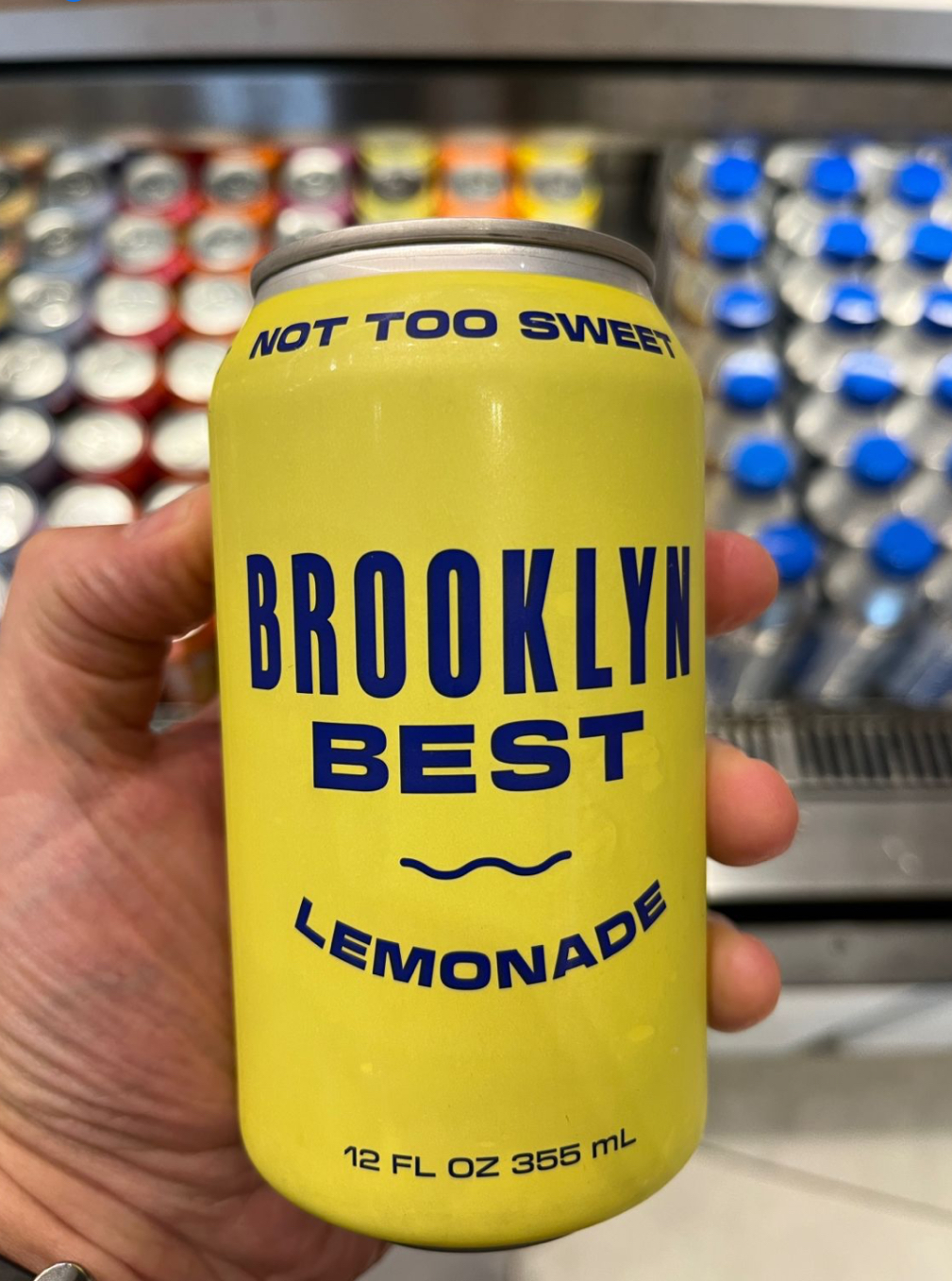
**NOT TOO SWEET**
I don’t like lemonade.
My objection?
It’s too sweet.
Brooklyn Best is reading my mind.
“Not too sweet.”
Sold.
I loved it.
Not too sweet. Not too tart. Just right.
The lesson?
Proactively bringing up objections defuses them.
**FORGIVE YOURSELF**
Here’s the worst mistake I made as a salesperson.
I lost two six-figure deals on the same day.
I was selling for Jellyvision, a digital agency in Chicago.
Best Buy and Circuit City (competitors) verbally committed to move forward.
I mistakenly copied Best Buy and Circuit City on the same email.
Within minutes of sending the email, both companies backed out.
Ouch.
I was shaking as I walked into my boss’s office to explain what happened.
I’ll never forget what she said to me.
“Forgive yourself.”
“You can’t become better when you believe you’re bad.”
Those encouraging words made me believe in myself rather than beating myself up for months.
I exceeded quota for the next 9 years.
The takeaway?
Mistakes happen.
Don’t be so hard on yourself.
Accept them.
Learn from them.
Forgive yourself.
**CRINGEWORTHY SALES ADVICE**
This sales advice that makes me cringe.
A prospect says:
“I need time to think about it.”
How do you respond?
Alex recommends saying this:
“It doesn’t take time to make a decision. It takes information. And I’m the only source of information you have to make the decision (Pssst, no, you’re not. There’s this thing called the Internet). So what are your main concerns?”
Alex continues:
“This is my favorite way to overcome sales objections because it forces people to make a decision today.”
My take?
Traditional selling is rooted in exercising control over people.
The seller comes from the position that they’re the keeper of information.
The seller knows what’s best.
It’s about persuading a buyer to decide what the seller has already decided.
Sellers use techniques to force decisions today so prospects stay on the straight line and buy.
Prospects don’t want to feel forced into making a decision today. Neither do you. Nobody does.
When people feel you’re taking their freedom to decide away, they resist.
People want agency over their decisions.
Trying to control and force people is manipulative and unethical.
It’s why salespeople have a bad reputation. The intent is to close a sale at all costs. To “keep” or only disclose information that’s in the seller’s best interest.
Non-persuasive selling is rooted in surrendering control.
The seller is the arbiter of information so that prospects can make the best decision for themselves even if that means, gasp, buying from a competitor or doing nothing.
Instead of forcing, it’s about understanding. Like this:
“It sounds like you have some concerns.”
“It seems like the value isn’t there for you.”
Chris Voss calls this labeling. You’re calling out the prospect’s emotion so you can discuss it.
The takeaway?
Understanding is the most important gift a seller can give a potential buyer (or anyone).
Less forcing. More understanding.
The golden rule? Sell how you want to be sold to.
**STORIES VS. FACTS**
Do you know the difference between stories and facts?
**NAPA VALLEY**
I hired Bob, a bike tour guide in Napa Valley.
He was in a bad mood.
He rushed through the vineyards and complained about the heat.
I was angry.
I wanted to leave him a bad review.
During lunch, Bob told me he recently lost his son to cancer. His name was Josh. He was 23.
I felt like an a-hole.
My anger was replaced with empathy.
When we view people’s actions through our lens, we think the worst.
A person is not defined by how they behave on Friday.
Everyone is going through something.
There are always multiple lenses to view things from.
The shift?
“Why is this happening?” -> “What's happening?”
When your default is to understand you’re kinder.
The golden rule?
Always give people the benefit of the doubt.
**YES THANK YOU**
I had a prospect disappear after telling me they wanted me to appear for a workshop.
When this happens, thinking hijacks my mind:
“Why did this happen?”
“What did I do wrong?”
“What could I have done differently?”
“How can I turn this around?”
When you expect a sale that doesn’t happen, you suffer.
Here’s the truth:
You can do everything right and not get the sale.
That’s because you don’t have full control over if or when people buy.
Prospects disappearing is the nature of sales,
just like flight delays are the nature of flying.
Pushing up against reality is a recipe for being unhappy and frustrated.
What’s the way out?
Detach.
To detach, I send this one-sentence email:
“Have you gone a different direction for the workshop?”
If I don’t get a response, I say to myself, “Yes, thank you.”
Now I can focus on people who are motivated to speak with me.
Prospect rude to you when cold calling?
“Yes, thank you. Now I know who not to call. There are thousands of other people I can reach out to.”
“Yes, thank you,” short-circuits the neuronal gossip.
Your ego doesn’t know what to do with “Thank you” so it dies. Albeit temporarily.
You’re left feeling calm and peaceful.
“Yes, thank you.”
**WHAT DO YOU KNOW ABOUT X?**
I’m at Fleet Feet in Delay, a locally owned running store.
I asked Kyle, the owner, to see the Garmin 945, a triathlon watch.
Here’s Kyle:
“What do you know about the 945?”
With one elegant open-ended question, Kyle draws out everything from “I own the Forerunner 630 and the 935” to “Not much. This is my first Garmin.”
In other words, how knowledgeable I am about the product.
Here’s me:
“I’ve read DC Rainmaker’s review, saw a few tutorials, and own the 935.”
Kyle: “What else do you want to know?”
Me: “I want to hear the volume of the audio through my headphones when running to see if the signal breaks up.”
Kyle: “Looks like you brought your AirPods. Let’s sync this demo 945 watch to your Spotify and headphones so you can give it a listen.”
Sold.
The lesson?
You sell to an informed buyer differently than to an uninformed buyer.
The Garmin 945 has lots of benefits: sports apps to track performance, wrist-based heart rate, GPS, and emergency response.
However, your product’s benefits only matter if they matter to your prospect. Don’t demo music to people who don’t like running with music.
Let go of assumptions.
Ask, “What do you know about X?”
People don’t buy because they understand you.
They buy because you understand them.
Buyers have the answers.
Sellers have the questions.
**KEEP IT CASUAL**
Casual cold email writing kicks formal writing’s ass.
Formal writing sounds like this:
“Hello Josh - We are currently collaborating with a sales trainer who conducts 23 Sales Kickoff Meetings (SKOs) annually. He has integrated AI-driven role-play scenarios using his proprietary materials to offer sales representatives realistic practice opportunities. This innovative approach enables him to charge a recurring fee for his services. I thought you might find this interesting.”
Casual writing sounds like this:
“Josh, we’re working with a sales trainer who does 23 SKOs/year. He’s using AI to role-play scenarios (with his material) to provide reps with realistic practice opportunities, allowing him to charge a recurring fee. Since you do SKOs, thought you might be open to learning more.”
Why does this matter?
Casual language feels more personal and conversational, making it easier for people to relate to your message.
Formal writing comes across as stiff and impersonal.
**SALES LAYOFFS**
Let’s talk about the real reason for sales layoffs.
A company gets funding.
VCs set growth goals.
VCs don’t understand sales, but they think they do.
They don’t take into account TAM and market penetration.
An Excel guru creates a forecast that shows doubling SDRs will double revenue.
The company hires 2X more SDRs.
Revenue doesn’t double even though there are twice as many SDRs.
Shocking.
Sales leaders blame SDRs.
SDRs are put on a PIP.
50% of SDRs are let go.
Sales leaders are let go.
New sales leaders are hired and pump up the board with a new forecast.
18 months later, they’re let go.
[title](url)**A CLASSIC SALES MISTAKE**
My wife, Jenna, walked into a Volvo dealership.
The salesperson treated Jenna like she didn’t know anything about the XC40 Recharge.
Here's the exchange:
Salesperson: “Hi, what brings you in today?”
Jenna: “I want to see the XC40 Recharge.”
Salesperson shifts into convincing gear:
“You’re going to love it.”
“The Recharge is pure electric.”
“Google is built in.”
“You get 226 miles of range.”
The problem?
Jenna spent the last three weeks watching videos and reading up on the XC40 Recharge.
She was further along in the buying journey. She probably knew more about the XC40 Recharge than the salesperson did.
Jenna came to the dealership to hear how loud the road noise was.
The salesperson's mistake?
He was selling everyone the same way.
When people knock on your door, they have different levels of knowledge ranging from “I don’t know much about X,” to “I’m very familiar with X.”
You need to sell based on the knowledge level of the prospect.
So Jenna left.
Because when you don't feel understood, that's what you do :-)
And bought the car from Richie Silverman who asked different questions:
“How much do you know about the XC40?”
“What would you like to know?”
“Okay, I’ll grab the key and won’t say word so you can hear the road noise.”
The lesson?
Adjust your approach based on where the customer is in the buying journey.
How?
Shift from convincing to understanding.
The lesson?
People don’t buy because they understand you.
They buy because you understand them.
**ENJOY THE JOURNEY**
My piano teacher said something profound.
Me: “I’d like to play Moonlight Sonata.”
Kristen: “Do you want to play Moonlight Sonata or do you want the experience of learning it?”
At first, I was confused.
But then it hit me.
I wanted the outcome: playing the song.
Kristen was suggesting I enjoy the process of learning music.
Why does this matter?
In many areas of life, we focus too much on the end goal and forget to enjoy the journey.
Fulfillment comes from the learning and figuring things out , not just the “song.”
Jenna with her new Volvo XC40.
“Never use a permission-based cold call opener.”
“Keep cold emails to under 60 words.”
“Always use an upfront contract during a discovery call.”
To the sales guru, these feel like facts, not opinions.
The guru really believes permission-based openers put you in a one-down or subservient position and therefore don’t work.
But someone who uses permission-based openers has success.
Every time you see a post from a sales guru, remember:
“This is from their point of view, based on what they’ve experienced.”
No matter how much conviction the sales guru has, most sales advice is not objectively true.
Everyone on LinkedIn is sharing perspectives not facts.
Try things for yourself.
See what works for you.
**911**
I drove my first 911 in 1978.
I was 8.
My father had just bought his first Porsche from Cherry Hill Porsche in Jersey.
He paid cash — they counted the bills on the desk.
It was such a significant moment in his life that he brought champagne and cheese to celebrate the occasion.
He also brought me.
We drove home together. My dad put his hand over mine so I could feel what it was like to shift.
At a red light, he asked if I wanted to steer. I climbed onto his lap and put two hands on the wheel. I'll never forget that moment.
It wasn't the car itself that made the moment special for me. I had no idea what a 911 was.
It was the shared experience and the connection between father and son.
It's good reminder.
Happiness comes from within.
From our relationships with others.
Not from external achievements, sales or possessions.
Me next to my dad's 911.
**DON’T HOLD PRICE HOSTAGE**
I asked a salesperson for the price.
I was taken back by their response:
“Let’s hold off on that until I learn more about your situation and show you the demo. I want you to see the value first.”
The problem?
I can’t determine value without price.
Salespeople don’t determine value, buyers do.
When you hold price hostage you destroy trust. Why? Prospects think you’re hiding something.
So if a prospect asks for the price, tell them the price, even if it’s a range.
Like this:
Prospect: “What’s the price?”
Salesperson: “There are a few variables but typically companies invest between X and Y. Can you see yourself falling in that range?”
Then shut the front door.
If your prospect doesn’t bring up the price bring it up early. Like this:
“I don't want to do you a disservice by wasting your time doing a demo, only for us to realize that although you like what you see we’re not fit because we’re too expensive. So based on what you told me so far, would it be okay if I ran some numbers by you?”
Price conveys certainty.
The shift?
Hold price hostage —> Set price free
**SAYING NO**
There have been so many times when I said “yes” when I wanted to say “no.”
I felt obligated to agree to avoid conflict or displeasing others.
I wanted to gain approval and be liked by others.
The problem?
Agreeing to too many requests made me feel like I was being spread too thin.
By saying “yes” to things that don’t align with my interests, I missed opportunities that were more fulfilling.
It was time to stop that.
How?
By realizing that learning to say “no” is a skill that can be developed and mastered.
You don’t have to feel guilty about saying “no.”
You don’t need to apologize.
It’s about being firm but kind.
For example, yesterday someone wanted to schedule a 30-minute pre-podcast meeting.
Here’s how I said “no”:
“You’re probably going to think I’m being difficult, but I don’t do pre-podcast meetings.”
Someone else asked to pay 50% of my fee after my talk rather than up front.
Here’s how I responded:
“No, that doesn’t work for me.”
Saying “no” feels liberating.
I think people respect you more when you say “no.”
**SHOW**
If I wanted my dream SDR job, I wouldn’t:
-Ask strangers for introductions.
-Send cover letters and resumes.
You’re an adult.
You don’t have to follow the rules.
I would send this cold email:
“Hi Tom,
I know you’re not currently hiring SDRs, but I think I can help [ACME] book more meetings with [Directors of HR.]
To show that I can add value, I built a cold email sequence and a cold call talk track.
I’ve also included a video here that provides you with my thought process.
Either way, I hope you find it useful.”
Show you can do the work.
**FAKE NICE**
Fake nice seems to be very en vogue right now in cold emails.
Fake nice sounds like this:
“Josh, loved your post on X.”
“Josh, your point about X was brilliant.”
“Josh, I’m truly impressed by …”
Most people don’t like sellers who are fake nice.
Why?
They know you have a hidden agenda to influence a certain reaction or behavior.
Fake nice is always followed by an ask, in my case, 30 minutes of time.
Instead of being fake nice, be direct. Like this:
“Josh, caught your interview with Voss. Are you open to interviewing other best-selling authors on your podcast? I have a few in mind that might be a fit.”
This shift?
Fake nice -> Direct
**YOU DON’T HAVE TO GROW TODAY**
There’s no need to:
Fix.
Change.
Solve.
Organize.
Improve.
You can:
Be still.
Simmer down.
Pause.
Reflect.
Observe.
My most creative ideas come when I’m still.
You don’t have to grow today.
**DON’T GHOST PROSPECTS**
Many moons ago, I was a salesperson for a digital agency in Chicago (Jellyvision).
The first time I spoke with someone at GEICO, they said:
“We don’t work with external agencies.”
So, I contacted a few other people.
Nobody was ready.
But I stayed top of mind.
From time to time, I sent ideas and articles aimed at helping them complete more online auto quotes.
One day, Jess, a senior exec, said he was meeting with Warren Buffett and wanted to pitch him our idea. He asked for help putting the deck together. I said yes.
You know how the story ends.
GEICO became a customer.
The lesson?
Staying top of mind is a valuable skill to learn and master.
Why?
People buy on their timeline, not yours.
Fruit doesn’t grow faster because it’s the end of the quarter.
Most people don’t fail at selling, they’re just not patient enough.
Don’t ghost prospects.
**QUESTION**:
“How do you draw the line between staying top of mind and being annoying?”
**RESPONSE**:
“What you’re sending matters. Do you find my posts or this book annoying?
You’re in my top of mind sequence right now. You’re reading my book. I’m selling every day, but it feels like I’m teaching you about topics you care about.
You might get to the last page, see my products and buy something.
Or not. It’s fine either way.
I don’t focus on what I don’t control.
I don’t chase, convince or beg.
If you don’t like my posts or this book, you can unfollow or block me.
I’m for some peopel but I’m not for everyone.”
**CARING**
Detaching doesn’t mean not caring.
You care about your cold emails.
You care about who you send them to.
You care about the message.
Once you send the email, you detach.
Why?
Everything else is out of your control.
You don’t fully control if your email gets opened.
You don’t control if your email gets read.
You don’t control if people respond.
There’s freedom in that.
There’s confidence in that.
There’s peace in that.
Surrender to the unknowing.
Care about what you control, not what you don’t.
**IT JUST IS**
If I could only give one piece of advice to salespeople, this would be it.
It’s three words.
“It just is.”
If you have a kid, see if this sounds familiar:
Parent: “Try the broccoli.”
Kid: “I don’t like broccoli.”
Parent: “But you’ve never tried broccoli.”
Kid: “I don’t like it.”
You could have the best broccoli in the world, but some kids don’t like broccoli.
Some kids hate broccoli, some don’t.
It just is.
It’s the same with selling.
You can do everything right and still:
Lose a sale.
Miss quota (aka a guess).
Get ghosted.
When you push up against reality you suffer.
Whenever you’re disappointed selling, remember to move in harmony with the nature of sales.
You can’t lose a sale you never had.
Let reality be reality.
It just is.
**WTF IS VALUE?**
The word “value” gets thrown around in sales so much.
It’s like the “I love you” of the sales world—sure, it sounds nice, but if you’re saying it to everyone, it starts to feel a little… insincere.
Imagine someone handing you a box and saying, “This is valuable!” but not telling you what’s inside.
You’d be like, “Uh, cool… but what is it? Diamonds or dog treats?”
The thing is, value is different for everyone.
What’s valuable to one person might be useless to someone else.
If you keep saying “value,” it’s kind of like saying “trust me” while winking. Nobody’s buying it.
So, what’s the way out?
Give people something genuinely useful that makes their life better. (Spoiler alert: case don’t do that.)
Here’s an example of providing real “value”:
_“Josh, since you’re new to fly fishing, I thought this video series on using the pinch technique when tying knots might be helpful. It’s useful for maintaining tension and precision so that knots form correctly without slipping or becoming loose.”_
When you show people something that’s useful, you’re not just talking about value—you’re delivering it
**DON’T FIGHT RESISTANCE**
“I want to think it over.”
Fighting vs. joining the resistance.
Fighting the resistance sounds like this:
“I understand. What’s a good next step?”
“I’ll call you this afternoon at 2:30. Fair?”
“Before I go, what were you wanting to go over in your mind just so I know what questions you have when we talk in two days?”
Whenever people feel like someone is trying to convince them their guard goes up. They did their heals in even deeper.
Joining resistance sounds like this:
“Seems like you’re skeptical that a tool can solve your commission problem.”
“Sounds like the value isn’t there for you.”
“Sounds like you’re looking at a few options.”
“Feels like something’s making you uncomfortable.”
“Seems like you want to shop around.”
“Seems like you’ve got something on your mind.”
“Sounds like you have some concerns.”
“Sounds like you’re leaning towards sticking with what you have.”
Chris Voss calls this labeling.
Labeling is an educated guess about what the prospect is probably thinking. If you mislabel, your prospect will correct you.
Labels unlock the floodgates of truth so you don’t waste time chasing.
If you guess wrong, people will correct you. Why? People like correcting, but they don’t like being corrected.
The shift?
Convincing -> Understanding
Don’t fight the resistance.
Join the resistance.
Verbal aikido.
**UNLOCKING TRUTH**
A prospect says:
“I need to discuss this with my boss.”
Resistance (what I call objections) carries one of two meanings:
It’s true. The prospect needs to have a conversation with their boss.
It’s not true. The prospect wants to end the conversation and avoid hurting your feelings.
The problem?
You can waste a lot of time chasing deals that won’t close.
So what you need is an approach to unlock more truth.
How?
Shift from overcoming resistance to understanding it.
Understanding sounds like this:
“I need to discuss this with my boss.”
1. Validate
“That’s not a problem. You want to get her input before moving forward.” (Pause.)
Can I ask you a few questions?
2. Check pulse.
“How do you feel about it?”
3. Understand.
“You know your boss, if I’m not overstepping, how do you think she’ll feel about it?”
4. Surface potential objections
“What do you think her biggest concern will be?”
There is no script for understanding. It’s less about what you say and more about being curious and listening without having an agenda.
Knowing how to unlock more truth is a good skill to master.
**YOUR PRICE ISN’T TOO HIGH**
Your price isn’t too high, even if prospects tell you it is.
Storytime.
Several months ago, I asked two general contractors (Chris and Peter) to bid on a home renovation project.
I clicked with Chris.
He was responsive.
He listened intently when I spoke.
He never interrupted.
He pointed out pitfalls I didn’t know about.
He made recommendations that aligned with what he heard.
He showed up at 9:55 for a 10:00 meeting.
Chris was 8% more than Peter.
Both were competent, but the 8% was worth the good feelings I had about Chris, so I hired him. I didn’t negotiate.
I told Peter I hired Chris.
When he asked why, my reflex response was, “Your price was too high.”
If Peter was 25% less, I might have gone with him, but that wasn’t the case.
I didn’t want to explain why I chose Chris because he was a better listener, so price was the easy button to say no.
The lesson?
In a world of similar products and services, you are the differentiator.
Focus on your listening skills, not your price.
**NO**
No, I won’t give you a discount.
No, I don’t want to sign your petition.
No, I won’t have a pre-podcast meeting.
No, I won’t share your post.
No, I won’t critique your cold email.
No, I don’t want a solar roof.
No, I won’t sign a service agreement or NDA.
No, I don’t want to subscribe to printer ink.
No, I won't wait 60 days to be paid.
No is one of my favorite words.
No is saying yes to boundaries and space.
What do you say no to?
**SELLING IS SERVING**
I learned a profound sales lesson from a server at a restaurant.
Most servers sell dessert by saying this:
“Would you like dessert?”
I always say, “No thanks.”
But that’s not what Jennifer at the Tin Muffin in Boca Raton said.
Here’s Jennifer:
Jennifer: “Are you afraid of desert?”
Me: “No.”
Jennifer: “We have many desserts, but there’s one that stands out. It’s our homemade banana cake. I have two kids and two cats, and this cake is my favorite thing in life. It’s life-altering, and I don’t like bananas. I think we have a few slices left, but I’m not sure.”
I said yes.
What does this have to with sales?
Selling is a transfer of confidence.
People can feel when you’re passionate about what you sell.
I told Jennifer that she was one of the best salespeople I’ve ever met. Jennifer said, “I’m not a salesperson; I just like serving great food.”
Like I said, a profound sales lesson.
Selling is serving.
Jennifer at the Tin Muffin in Boca Raton, Fl.
**THE WAITING TAX**
You’ve been there.
Your prospect tells you they have a problem you solve.
But they don’t buy.
Why?
Storytime.
My shower head drips every 2 minutes.
It’s a problem, but it’s not that intense.
It’s no big deal.
I can make progress.
I’m getting the job done.
If you tell me it costs $650 to fix it, I wouldn’t buy.
Why?
I have limited resources.
So do you.
So does everyone.
There are other problems that are higher on my priority list.
But that’s not what happened.
I called Nick, a plumber.
Here’s Nick:
Same feelings.
Cold calling just is.
The nature of cold calling is:
People who are open to talking with you.
Getting a referral.
Booking a meeting.
Dialing with no answers.
Wrong numbers.
Rude people.
Resistance.
Rejection.
People who agree to a meeting and don’t show.
Charge your energy to be positive.
How?
1. Instead of focusing on the outcome, be curious about what you might learn from the process.
2. Focus only on what you control. Ask a question about a potential problem and then let what happens happen without expecting anything to happen. “Josh, I know your LinkedIn posts drive sales of your courses. How are you reaching reps that don’t see your posts?”
3. Be grateful. There are millions of people who would consider their prayers answered if they could cold call. Or to even to read this book.
Cold calling doesn’t suck, it’s a privilege.
Different thoughts.
Different feelings.
**ASKING FOR FEEDBACK**
I'm shocked by how few salespeople do this.
The cost? $0.00.
It’s asking prospects who ghosted you for feedback.
Here's how to ask for feedback:
1. Create a list of prospects who have ghosted you (people who expressed interest but didn't show for a meeting).
2. Send this email:
"Hi Beth, It looks like you’ve decided not to proceed with the cold call workshop. Perhaps I dropped the ball somewhere along the way.
Here’s my ask (and I know it’s an ask because you don't owe me a response.)
Would you be open to providing feedback so I can serve you better should a need arise in the future? Was it my terms? Price? Did you find someone else who was taller?
Either way, I know there are lots of people competing for your time and resources, so thanks for taking the time to look at my workshop.”
Why this works:
When you let go of the sale, prospects lower their guard and tell you the truth because they don't feel pressured.
**APPROACHING PROSPECTS AT CONFERENCES**
It’s inevitable.
Sooner or later, you’ll be at a conference or networking event.
And that means you’ll need to approach prospects.
How do you strike up conversations with prospects without it feeling awkward?
Pop quiz:
Imagine a cocktail party.
Whose approach feels less awkward?
Matt or Mandy?
Here’s Matt:
“Hi, I’m Matt. How about those Olympics? I can’t believe how fast humans can run 100 meters. Did you see Gabby Thomas? Crazy, right?”
Here’s Mandy:
“Hi, I’m Mandy. I’d like to have a conversation with you, but I’m not sure how to start because I don’t know anything about you.”
You know the answer.
You don’t have to be confident and suave when approaching prospects at networking events.
The more you acknowledge the awkwardness, the less awkward the conversation is.
**TAME THE MIND**
I’m white water rafting.
The river is rough.
I’m navigating the raft, focusing on not tipping over.
My heart is racing.
Afterwards, I observed the same river.
My perspective shifted.
The river isn’t rough.
The river is constantly changing.
There are calm parts.
Calmer parts.
Rough parts.
Rougher parts.
When you’re thinking about navigating the river, your mind races.
The thinking mind can’t relax.
When you observe the river, you turn the volume down. You calm down.
Why am I talking about this?
In sales, we’re attached to things.
The sale.
The meeting.
President’s Club.
The top of the leaderboard.
Cold email response rates.
Hitting quota.
Things, trips or metrics aren’t the problem.
It’s attaching our happiness to the thing that causes suffering.
You get upset if you don’t have the thing that others have or that you want.
The way out?
Detach from the outcome.
How?
Here’s a simple exercise you can do wherever you are.
Observe your thoughts without judgment.
On Slack? Observe your thoughts.
In a meeting? Observe your thoughts.
Play a game of how many times you can observe your thoughts per day.
The simple act of noticing builds your detaching muscle.
With practice, you spend less time lost in thoughts and more time noticing them.
Like a river, you realize prospects are coming in and out of your life all the time.
Same with quota.
Everything changes.
Detaching is so freeing.
Taming the mind is good skill to practice.
**THE ART OF NOTICING**
There is a war for your attention.
Advertising.
Cold emails.
Cold calls.
Slack.
Chat.
LinkedIn.
TikTok.
All of it hogs your attention.
Distracts you.
If you’re like me, you don’t even realize your attention is being hijacked because social media is so addicting.
Why does this matter?
As William James said, “Our life experience will equal what we have paid attention to, whether by choice or default.”
How you spend you days is how you spend your life.
How can you steal your attention back?
Here’s what I did today.
I spent 20 minutes noticing what I see, smell, taste and feel as I walked the beach.
Finding interest in the everyday reprograms your brain to pay attention.
Taking a break from screens to notice your environment helps reboot your brain.
I can’t think of a better way to spend 20 minutes.

**I’m Bored**
I’m at a spectacular Airbnb in Bolinas, CA.
I’m bored.
So I asked the owner, Nancy, for recommendations of things to do.
I was expecting hikes, restaurants, farmers’ markets, events, activities.
Here’s Nancy:
“There is a bench outside by the edge of the fence on the ocean side by the big cypress. It’s nice to just sit there and watch the surfers and the birds.”
It’s a good reminder.
Boredom can be uncomfortable.
We want to do something to avoid the feeling of doing nothing.
Whenever I see people waiting in line at Starbucks, they’re scrolling on their phones.
It’s easier now than ever to avoid being bored.
Infinitely scrolling on social media.
Endless hours of entertainment on Netflix & Spotify.
When we rely on tech to avoid feeling bored, we undermine our sense of self as the authors of our own lives.
If you can’t put down your phone, you don’t have a phone, the phone has you.
Nancy taught me:
You don’t need to constantly seek activities to occupy yourself.
By simply sitting and observing the “surfers and birds,” you can rewire your brain to find joy and peace in the everyday.
Be empty.
Be still.
Just notice things coming and going.
Getting better at being bored is an undervalued skill.
I’m definelty under construction in this area.
Are you?
The bench at Nancy's place in Bolinas California.
**WHAT DO YOU DO?**
Chances are someone has asked, “What do you do?”
Here’s the run.
You’ve probably never be taught how to explain what you do in a way that invites people to care and motivates them to want to learn more.
Why does this matter?
When prospects are confused, they don’t buy.
Confusing people sounds like this:
Prospect: “What do you do?”
Salesperson: “Calendly is a business communication platform used for teams to schedule, prepare, and follow up on external meetings.”
Treat buzzwords (business communication platform) like a hot stove. Don’t touch them. Everyone uses buzzwords so they don’t mean anything.
Clarity sounds like this:
Prospect: “What do you do?”
Salesperson: “With Calendly, you paste a link into your email and schedule meetings without going back and forth to find the perfect time.”
See the framework?
With A, you do B, and C happens without D.
Example for Grammarly:
“With Grammarly, you type your text, and it automatically corrects spelling and grammar errors without needing to proofread manually.”
Your turn.
Use this framework to explain what you do.
**NO LEADING QUESTIONS**
Do you ask leading questions?
“Can you imagine the advantages of [using our product/service] in your day-to-day operations?”
“Do you see the value in implementing [solution] to streamline your operations?”
“Is breathing air a priority for you?”
“If I told you something interesting, would you be interested?”
The problem?
The moment prospects feel they’re being led to a desired answer trust erodes.
Why?
People can smell your commission breath. They know they’re being led into a yes trap.
The way out?
Ask a neutral question related to a potential problem with the current solution.
It’s a potential problem, because it’s only a problem if it matters to the prospect.
For example, imagine you’re selling an iPod in 2001.
The prospect tells you they’re using a Diamon Rio.
The problem? The Rio only holds 30 minutes of music.
Not a big deal if you have less than 30 minutes of music.
But a hassle if you do and want to switch it out.
Example for an iPod in 2001:
“As you know the Diamond Rio holds 30 minutes of music. How are you dealing with that when you go on longer runs? Are you listening to same songs on repeat or do you switch them out when you get bored?”
“You’ve probably considered an iPod.”
See what I did there?
I asked a neutral question that illuminates a potential problem with the current way without leading people to a desired answer.
And I presupposed the prospect is familar with the iPod, because chances are they are. If they’re not, that’s okay, they’ll correct you.
The takeaway?
It's not your job to lead people to a desired answer. Your job is to make people think differently about their current solution.
Why does this matter?
People are more likely to be persuaded by what they hear themselves say rather than what a salesperson says.
**GOOD COLD EMAIL COPY IS FOUND**
Good cold email copy isn’t written.
It’s found.
I stole words from this testimonial for the Knot Needle to write the cold email below.

__
Subject: Casper
_Hey Josh,_
_Looks like you’re heading to Casper in a few weeks_.
_How are you ensuring you don’t spend 10+ minutes rigging a simple double drop nymph setup?_
_Over 3,000 beginner fly fishers use our tool to tie Orvis + Triple Surgeon knots in seconds. Just grab the tag end and sew your knots._
_Think this might come in handy?_
_Either way, if you have the time, check out Pathfinder Reservoir. It’s a great honey hole for big trout and walleye._
__
**Why does this matter?**
When you join the conversation already taking place in your prospect’s mind, they subconciously think, “You get me, what do you have?”
The idea is to be specific or crispy. When your copy is crispy you’re more believable.
Your customers are better at writing cold emails than you are.
**RAGING BULLS**
A friend of mine found a blender blade in her acai bowl today.
Fortunately, she wasn't injured.
When she notified the owner, he said, "Sorry about that. Here's a coupon for a free bowl."
She was pissed. She charged at the owner like a raging bull:
”This could have split my tongue wide open!”
Jean-Louis Gassée, who used to run Apple France, describes this situation as the choice of the two tokens.
When you deal with an upset person, you can choose to take a token that subconsciously says, "It's not a big deal," or the token that says, "It's the end of the world." Whichever token you pick, they'll choose the other.
If the owner chose the "it's the end of the world" token, he might have said something like this:
"OMG! I'm so sorry. Are you okay? I'm so embarrassed. Here's a punch card for 25 bowls. I know this doesn't make up for the trauma this caused you. I'm going to shut down the store until every blender passes an inspection test. I'm also going to bring this to the manufacturer's attention. Again I am so sorry about this."
If the owner said that, my friend wouldn't have been so pissed because she would have chosen the "it's not a big deal" token.
The takeaway?
When you experience a raging bull, choose your token wisely.
The blender blade in the acai bowl.
**RUDE PEOPLE**
When you cold call…
Some people will be rude to you.
What you say won’t change that.
They just don’t like cold calls.
And there’s absolutely nothing you can say to change that.
So don’t try to convince rude people to talk with you by begging for 30 seconds.
Once you’ve done your best and they’re rude, don’t do more.
It’s just the nature of sales and your job is to accept it just as it is.
Call someone else.
Most people aren’t rude.
Let reality be reality.
**ELEPHANTS**
My neighbor Sam asked if I wanted to grab lunch.
I didn’t want to go.
But I also didn’t want to hurt Sam’s feelings.
So, I told a white lie:“I can’t. I’m working on a big presentation.”
What does this have to do with sales?
Prospects (aka humans) often try to avoid uncomfortable situations or conflicts, especially in social settings.
By telling a white lie, prospects sidestep the discomfort of potentially disappointing you or having an awkward conversation about their true feelings.
The solution?Call out the elephant in the room. Like this:
Sam: “I’m getting the feeling that you don’t like going out for lunch.”
Sales examples:
“I’m getting the feeling this might not be the right fit for you.”
“It seems like there might be some hesitation about moving forward.”
“Won’t there be internal pushback from your CFO?”
“It seems like this might not be a priority for you.”
“It feels like you might be concerned about implementation.”
Why does this matter?
By calling out the elephants, you create a safe space for an honest conversation, making it easier for people to express their real concerns.
Just because you don’t call out the elephants in the room doesn’t mean they’re not there.
No truth, no trust.
No trust, no transaction.
**HAVING A PURPOSE IS B.S**
I spoke with Mel, a 76-year-old retired man.
I asked him what his purpose was now that he was retired.
His answer surprised me.
“Having a purpose is B.S.”
“My purpose this morning was to drink coffee and read. My purpose right now is to swim. I have no idea what my purpose will be when I’m done swimming.”
“Seeking purpose creates pressure and makes people depressed.”
“I don’t need KPIs to have a purpose.”
“Instead of chasing a purpose, I choose to be curious.”
“Try new things.
Swim.
Surf.
Paint.
Eat a snail.
Mold clay.”
“Your purpose is to be here. That’s enough.”
It’s a good reminder.
Our purpose isn’t our job.
That’s just a lie we’ve been told that keeps us working eight hours a day.
What if we pursued creativity instead?Followed our passions.
See where it takes us.
Our purpose might simply be to support that.
Work can fund creativity, but work shouldn’t define us.
The shift?
Seeking → Being
A few years ago, I was in the mall with my wife.
I didn’t need anything.
To kill time, I walked into a Fit2Run store.
10 minutes later I spent $170.
Here’s a transcript of the conversation.
Seller (notices running shoes): “Looks like you’re a runner.”
Me: “I am.”
Seller: “Training for any races?”
Me: “Yes, my first half marathon.”
Seller: “You’ve probably had a running gait test.”
Me: “What’s that?”
Moments later, I’m on a treadmill.

Seller: “See how your ankles are overpronating?”
Me: “I do. So what?”
Seller: “The problem is, if you run in sneakers that aren’t made for pronated feet, you are more prone to plantar fasciitis and runner’s knee. If you’d like, I can see if your shoes are made for pronated feet.”
A few minutes later, I spent $170 on new sneakers.
No pushing.
No expectations.
No assumptions.
Illuminating a potential problem and leaning back.
The switch?
Problem asking -> Problem finding
**REWIRE YOUR BRAIN TO LISTEN**
I got back from visiting Bolinas, California, a few weeks ago and was talking about my trip with a friend.
One second after I said, “I just returned from an amazing vacation in Bolinas,” my friend replied, “I’ve been there. It’s a cool place, but I prefer Sausalito because …”
This is what happens when you listen to talk.
You’re thinking about what you want to say instead of paying attention to what the other person is saying.
The problem?
When someone interjects with their own thoughts instead of listening, you feel ignored or undervalued, as if your experiences or opinions don’t matter.
People can feel when you’re listening to talk.
Yes, it’s a feeling.
It’s not my friend’s fault.
His brain is on autopilot. He has a thought (Sausalito) and speaks.
He hasn’t trained his mind to listen.
How do you train your mind to pay attention?
Here’s a simple exercise:
The next time you’re at a red light that turns green, pause.
Look to the right.
Then look to the left.
Then go.
Why?
In addition to possibly saving your life from being t-boned, you’re training your brain to respond instead of react.
You’re creating a gap between your thought (green means go) and your response (going).
As you go through this process, attention becomes a muscle that gets stronger.
With practice, you’re able to divorce your action from your thought.
You think, “I want to talk about Sausalito,” but in the gap, you decide to say, “What do you think of Bolinas?”
Get your reps in.
Rewire your brain to listen.
**YOU DON’T SELL TO DOGS**
My brother Jason founded Animal Pharmaceuticals.
He sold his company in 2021 for $40m.
No employees. Boostrapped.
One of his products was Cherry Blossom Body Spray.
Here’s me:
“Do dogs like smelling like cherry blossoms?”
Here’s Jason:
“I’ve been selling pet products for 21 years. And I've never sold to a dog. I sell to people who have a dog.”
It's a good reminder.
You’re not selling to:
B2B.
Industries.
Companies.
Verticals.
Pet owners.
People.
Dogs.
You’re selling to people who have a dog.
Know your buyer.
**LIGHT THE WICK**
I used to be 52 pounds heavier.
A friend bought me a few sessions with his personal trainer, Krys.
Here’s what Krys told me on day 1:
“Walk around the block one time then FaceTime me when you’re done.”
I did.
Here's Krys:
"Awesome job Josh! You just lit the wick!"
One block turned into two blocks.
Two into four.
Four into a Fitbit and five thousand steps.
Then ten thousand steps.
Ten thousand steps to a spin class.
Spinning into cycling outside.
Then swimming.
And running.
Then I finished a 70.3-mile Ironman in Mont Tremblont.
Here’s what I learned.
Success doesn't take superhuman steps like doing 100 burpees. Or ripping 100 dials a day.
One cold call, then two. One block, then two.
3% of each paycheck into a boring index fund.
Things that appear so tiny they almost feel insignificant.
Simple daily habits repeated consistently add up over time.
You can create whatever success you want. But you have to do something.
You have to walk around the block. Stick to a routine.
Build tiny habits rather than focusing on the goal. Running not finishing.
Finishing is a byproduct of doing.
Success doesn't happen in an instant.
Most people don't fail. They're just not patient enough.
Light the wick.
Crossing the finish line at Ironman 70.3 Mt. Tremblont.
**POKE THE BEAR**
I wanted to buy an expensive road bike.
A Pinarello Dogma F12 in Vanician blue.

It was $12,000 without pedals.
I called three bike shops asking if they had the bike in my size.
Two shops said they had the bike in stock.
When I called the third shop, Racer’s Edge in Boca Raton, and asked if they had the bike in my size, John, the owner, said this:
“We don’t sell bikes that way.”
Me: “What do you mean?”
John: “The problem with the Pinarello Dogma F12 is that you ride it for 30-40 miles and discover you’re not comfortable and it can’t be adjusted to fit you. So you end up selling it it at a 40% loss.
”The correct position keeps your body aligned on the bike, helping to prevent injuries while making you comfortable and relaxed.”
“That’s why we do a 2-hour bike fitting first before recommending a bike.”
“We have more fitting experience than any other shop in the area with over 10,000 fittings.”
I booked a fitting and bought a Specialized S-Works SR7 Snake Eye bike from John.
It was $13,000 without pedals.
Why?
John poked the bear.
He shined a light on a problem I didn’t know about.
He had a point of view.
The lesson?
To stand out, you need to stand for something.
What do you know that your prospect doesn’t know that can hurt them?
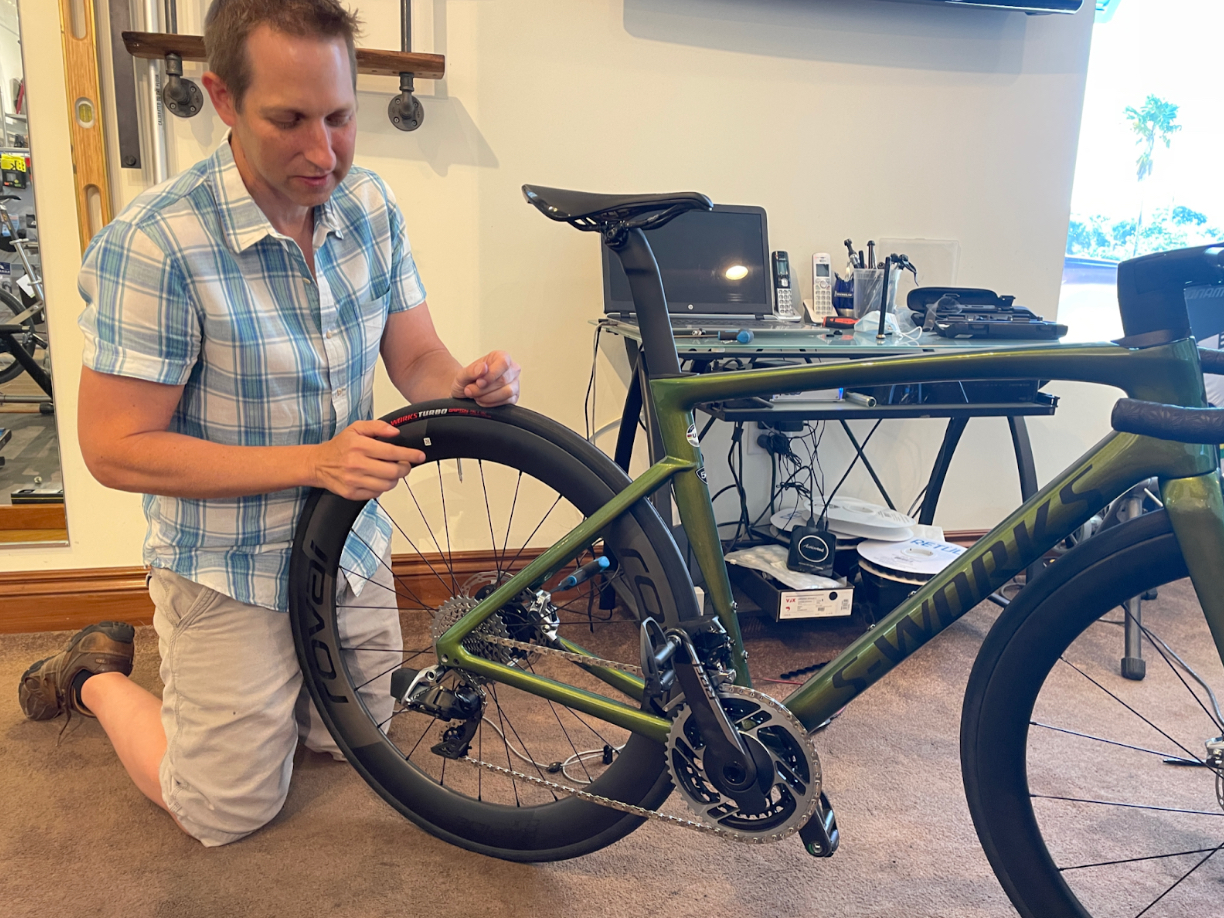
Specialized S-Works SR7 in snake eye green.
**FLAUNT YOUR FLAWS**
If you want someone to buy your product, you need to present it in the best light possible, right?
Not so fast.
Storytime.
Richard is a top-producing real estate agent in Chicago.
I met him while looking for an apartment to rent.
Here’s the first thing Rich said when he showed me an apartment on Chestnut and Rush:
“This apartment doesn’t have central A/C, which some people find noisy, especially when they’re sleeping. If you’d like, I can turn it on so you can see for yourself. If you’re okay with it, and are looking to get into the Gold Coast for under $3k per month, this unit would be on my short list.”
Bringing up the negatives makes the positives more credible.
When you tell someone, “Here are the positives and here are the negatives,” you build more trust than saying, “Here’s why this apartment is right for you.”
Why does this matter?
In a world of similar apartments, trust is why people choose you.
No trust, no transaction.
Flaunt your flaws.
**THE BEST COLD CALL I EVER RECEIVED**
The best cold call I had ever received.
It was from Kendra Warlow formerly at Gravy Solutions.
Here’s a transcript of the conversation.
Me: “Hello.”
Kendra: “Josh, it’s Kendra with Gravy. I didn’t expect you to pick up. I’m going through the Starbucks drive-through right now.”
Me: “What are you getting?”
Kendra: “A Caramel Frappuccino. I make it taste like a Twix bar with add-ons.”
Me: “Ha! What can I do for you?”
Kendra: “I know you have a few courses. Are you using internal resources or an outsourced recovery team to recover failed payments?
Me: “I use Stripe for that.”
Kendra: “It sounds like you’re frequently running a failed payment report in Stripe.”
Me: (Secretly thinks, “Hmm, I’m not sure.) “Actually, I’m not doing that.”
Kendra: “That’s pretty common (normalizing reduces pressure). If you’d like, I can send you instructions on how to run the failed payment report in Stripe so you can see if this is even an issue.”
Me: “That sounds good.”
As promised, Kendra emails instructions. I ran the report—no failed payments. But if I ever bump into this issue, the only company I’m calling is Gravy.
Why?
I trusted Kendra because she didn’t assume I had a problem.
In other words, she put my best interests before hers (booking a demo).
In a world of similar products, trust is why people choose you.
The shift?
Transaction —> Trust
**DETACH**
Marty’s been fly fishing three months a year for 52 years.
He took me with him to the Rainbow River in Utah.
It was my first time fly fishing.
Marty gets a strike and sets the hook.
After 13 minutes, the fish jumps in the air, thrashes around, and shakes the hook.
Here’s me:
“I can’t believe it got away! After all that effort, 21 minutes for nothing! This is so frustrating!”
Marty said in a calm voice:
“That’s fishing.”
Then he begins casting again.
Marty wasn’t attached to the outcome.
There’s power in that.
There’s confidence in that.
He tunes out what he doesn’t control (landing a fish).
He tunes in to what he does control (casting, flies, location).
It’s the same with sales.
If you get an angry fish that says, “How the ‘f’ did you get this number?!?” you can lean back, detach, and say in a calm voice:
“We use a product called ZoomInfo, which has a list of people’s phone numbers. There are two numbers listed for you, a direct line and a cell. Seems like it’s inappropriate for me to have called this number.”
Then let what happens happen without expecting anything to happen.
Detach from the outcome.
Cast again.
The trout that got away.
**YOU’RE NOT FOR EVERYONE**
Popular sales advice I disagree with:
“No is not yet.”
Imagine this scenario:
You sell grass-fed beef.
You call a prospect.
You pitch.
The prospect says, “No thanks, I’m a vegan.”
What do you say?
I posted this scenario on LinkedIn.
421 salespeople weighed in.
87% of salespeople treated “No thanks, I’m a vegan” as an objection rather than a truth.
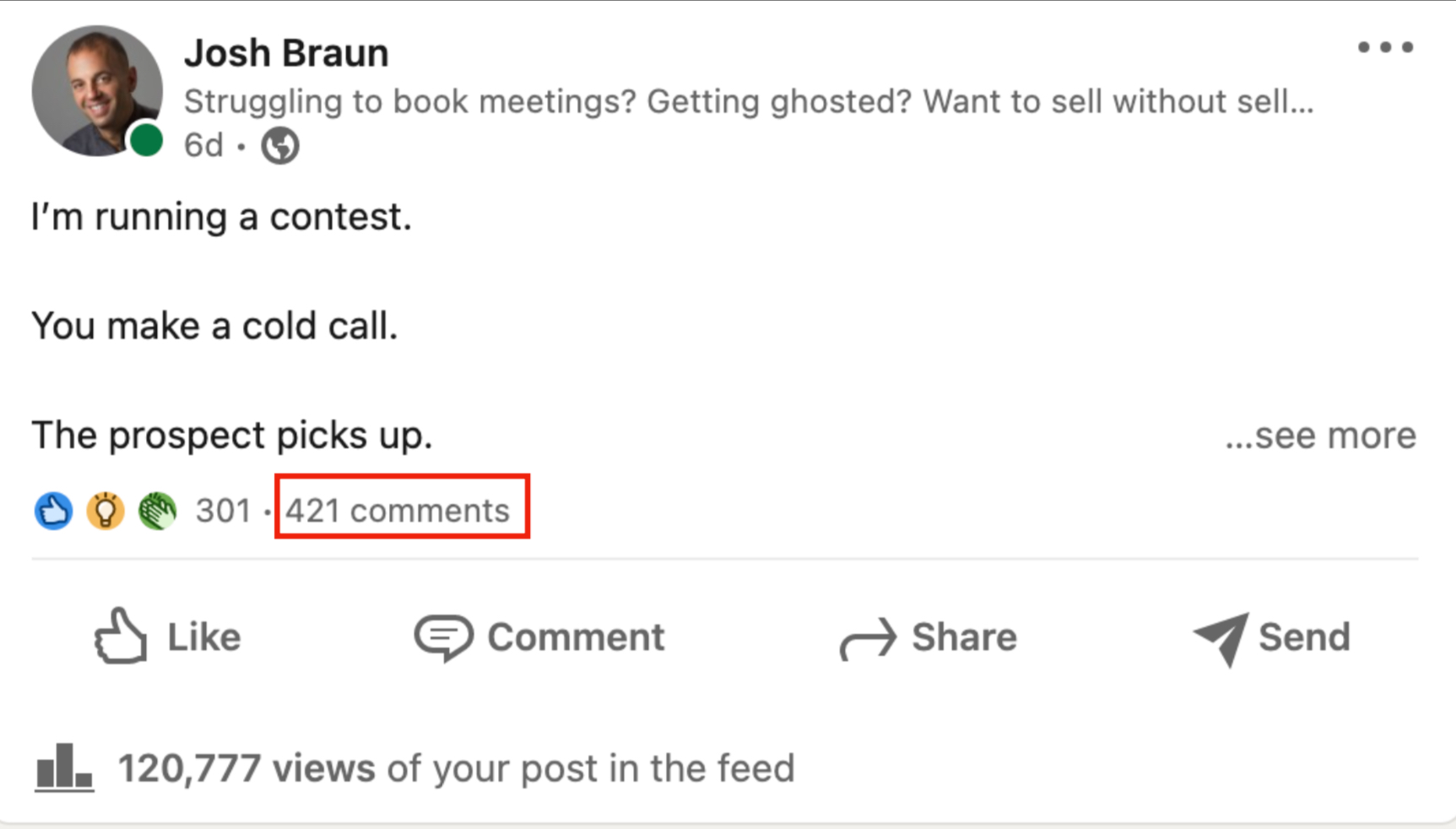
When you treat truths like objections, you say things like this:
“I understand how you feel. Many vegans felt the same way. But what they found is that our beef was grass-fed, so they gave it a try.”
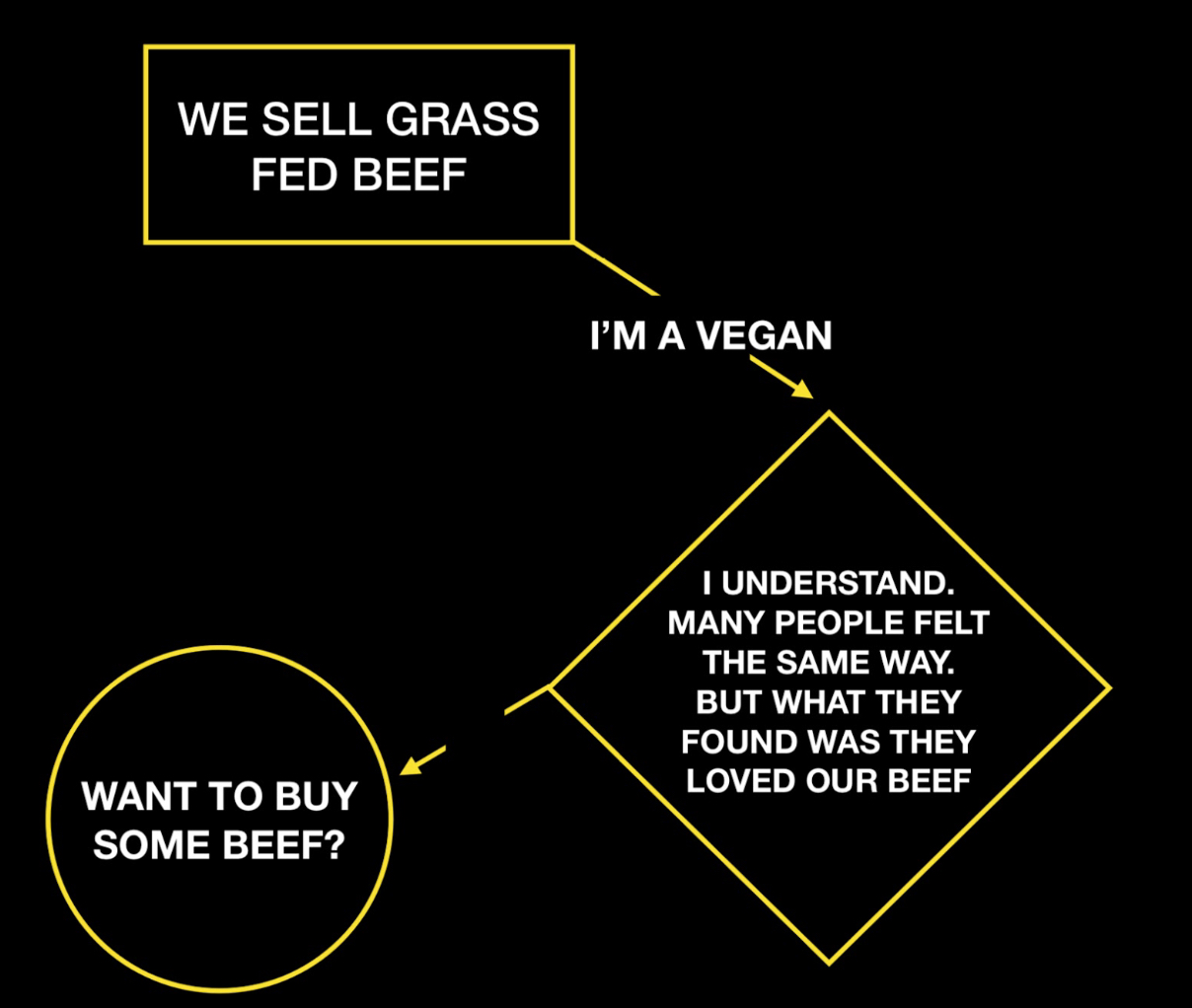
Intent matters.
When your intent is that no means not yet, you behave in ways that feel pushy because you assume you’re a fit for everyone.
The way out?
Let go of assumptions, like this:
“Cool. Sounds like we’re not a fit.”
It’s not your job to talk vegans into buying meat.
Your beef is for some people, but it’s not for everyone.
There are so many people who aren’t vegans.
Call them.
**UPSELLING**
Pop quiz.
Which tactic is the fastest path to revenue?
A) Reaching out to people you don’t know.
B) Selling additional products or services to customer.
You know the answer. B.
Your customers know and trust you.
Strangers don’t.
How do you sell people additional products or services without sounding pushy?
Storytime.
I bought a bike from Racer’s Edge in Boca Raton.
Here’s the post-sale conversation with John, the owner.
“What type of bike lights are you using?”
“Ravemans.”
“Those are popular lights. 2,000 lumens. How do you like them?”
“They’re great.”
“Do you use a mirror to see cars approaching from behind?”
Me: “No. I turn my head around and look.”
John: “You’ve probably heard of the Garmin Varia.”
Me: “What’s that?”
John: “With the Varia, you can see cars approaching from behind without moving your head.”
Me: “How does it work?”
Curiosity piqued.
A few minutes later, I spent $803
Illuminating problems or opportunities is a sales superpower.
Buyers have the answers.
Sellers have the questions.
**THE $32 SANDWICH **
I gladly paid $32 for this corned beef sandwich at Katz's Delicatessen in NY.
Stacked high, perfectly seasoned, melt-in-your-mouth meat.
They've been making it since 1888.
Best I've ever had.
The lesson?
Price is the last refuge when buyers don't perceive your product as being meaningfully different.
Extra lean corned beef sandwich at Katz’s in NY
**DO IT AFRAID**
In 2017, Alex Honnold stunned the world when he became the first person to climb El Capitan, a 3,000-foot ascent in Yosemite National Park.
Without ropes.
How did he overcome the fear?
Here’s Honnold:
“I practiced the moves over and over again. I worked through the fear until it wasn’t scary anymore.”
It’s the same thing with cold calling.
You do it afraid.
You practice over and over again until it’s not that scary anymore.
Fear is part of training your mind.
Do it afraid.
Garmin RTL515 Varia Rearview Radar and bike computer.
**BE CRISPY**
Your prospect’s inbox is crowded.
Your prospects are receiving an avalanche emails every day that sound the same.
If a prospect doesn’t read your message and think, “Hell yeah, that’s what I need,” they think “No” and move on.
How do you get your prospects to think, “Hell yeah?”
Don’t be vague.
Be specific or “crispy.”
Vague:
“Ever wish you had B2B leads?”
Prospect: “No.”
Still vague:
“Ever wish you had B2B SaaS leads?”
Prospect: “No.”
Crispy:
“Ever wish you had validated email addresses and direct phone numbers for Directors of Business with at least 15 SDRs who are in the market for cold calling training?”
Prospect: “Hell yeah!”
When you’re crispy people are likely to relate to your message.
Why?
As legendary copywriter Robert Collier say, you’re joining the conversation already taking place in their mind,
Do your cold emails make prospects say “Hell yeah” or “No”?
**BE EQUAL**
Down, up, and equal positions in sales.
Down (needy):
"Please call me back."
"Have you read the proposal?"
"What do I need to do to win your business?"
Up (arrogant):
"We're the best."
"Here's why we're a fit."
"We can 10X your sales."
"You need us."
Equal:
"I need to know more to determine if we're a fit. Can I ask you a few specifics about X?"
"You mentioned that your SDR team is new. Would monitoring this issue for a few months before bringing on a sales trainer make sense?"
"Not sure about you, but many of the SDRs we work with tell us they only talk to 2-4 people per 50 dials. How does that compare to what you're seeing?"
Be equal.
**WILD HORSES**
Think about prospects as wild horses.
You go on LinkedIn and see a horse.
You think:
“That horse fits my ideal customer profile.”
“That horse has the right title.”
“We could do a lot for this horse.”
“I want to ride this horse.”
The problem?
The horse is wild.
You want it to go this way, but the horse wants to go that way.
You want the horse to take a next step, but the horse rears up and bucks you off.
You can’t climb on a wild horse and ride it.
Why?
Because wild horses don’t like being told what to do.
First, you have to tame the horse.
To tame a horse, you can:
1. Beat it into submission by trying to control it (the traditional sales approach).
2. Offer the horse something nice to eat, stroke it, and gradually gain its trust.
Over time, you get the horse to lower its guard and be calmer.
The horse thinks, “You’re not going to harm me.”
“It would be nice to work with this person.”
“I want to be trained.”
“I trust this person.”
Likewise there are two ways to sell.
You can force people to do what you want them to do, but eventually, prospects will rebel. That’s because autonomy is a basic human need.
Or, you can get prospects amenable to lowering their guard, so they want to change. They think it’s fun, not an ordeal.
For example, you’re reading this post.
I’m “selling,” but it doesn’t feel like I’m trying to force you into doing something.
You’re enjoying reading this post.
Some of you might head over to my website and buy something.
I call this The Way.
It’s selling without pushing, convincing or begging.
Why are some salespeople so pushy?
They’re attached to the outcome.
Here’s why:
When you’re attached to the sale, you behave in ways that feel pushy.
You say things like:
“I’m just checking in.”
“Did you read the proposal?”
Your intent affects how you behave.
There’s a popular neuroscience phrase that describes this, “Neurons that fire together wire together.”
Same intent.
Same behavior.
Here’s the truth:
Buying takes longer than you anticipate. It’s gradual, then fast at the end.
Selling requires patience.
Like fruit ripening on a tree.
Fruit doesn’t ripen faster because it’s the end of the quarter.
When people aren’t ready to switch, instead of pushing harder, provide water and sunlight so you stay top of mind.
Someone hired me last week for an SKO who has been following and sharing my posts for three years.
I’ve been following up for three years without chasing, pushing, or convincing.
When they came back, the sale closed in one day.
Gradual, then fast at the end.
Ironically, the less you’re attached to the sale, the more sales you make.
People buy on their timeline and for their reasons, not yours.
Different intent.
Different behavior.
**THE WAR FOR ATTENTION**
There is a war for your attention.
Advertising.
Cold emails.
Cold calls.
Slack.
Chat.
LinkedIn.
TikTok.
All of it hogs your attention.
Distracts you.
If you’re like me, you don’t even realize your attention is being hijacked because social media is so addicting.
Why does this matter?
As William James said, “Our life experience will equal what we have paid attention to, whether by choice or default.”
How you spend your days is how you will spend your life."
How can you have more control over our attention?
Here’s what I’m doing.
I’m in Bolinas, California.
Every day for 20 minutes, I observe what I see, smell, taste, and feel as I walk the beach.
Finding interest in the everyday rewires your brain to be more deliberate about what you pay attention to.
**MATCH THE HATCH**
I learned how to flyfish.
Here’s the first thing my guide said to me:
“To attract fish, you need to use flies that mimic the bugs in the water.”
“These are nymphs.”
“Fish are more likely to bite if the fly resembles their natural prey, which right now are these guys.”
“It’s called matching the hatch.”
In sales, you have to match the hatch too.
Your prospects are more likely to “bite” when you match the conversations already happening in their heads.
How do you match the conversation aleady happening in your prospect's head?
Mine success stories for quotes about what sucked before the customer switched – AKA the “before story.”
The key is selecting words within quotes.
Extra points if you find emotionally charged words like “nightmare.”
For example, here’s a before story quote I found in the HEY customer success story:
“Been using HEY several weeks and no longer dealing with spam, long lists of “unread” messages, or sorting out annoying but important docs.”
And here’s how I used it in a cold email:
“Ever wish you no longer needed to deal with spam, long lists of ‘unread’ messages, or sorting out annoying but important docs?”
The big idea?
Good messaging isn’t written; it’s found.
Match the hatch.
**9 THINGS I LEARNED ABOUT SALES**
The first thing I sold was washing cars.
I was 14.
Here are 9 things I learned that helped me sell better.
Perhaps what I learned can help you learn to sell better too.
Nyphms on a rock at the Rainbow River is Duchesne Utah.
**BLAME OR RESPONSIBILITY**
Many years ago I spoke with two salespeople, who both missed quota.
When asked what happened, one said, “It wasn’t my fault; my territory change and I didn’t have as many leads.”
The other responded, “I missed because I didn’t prospect as much over the phone. I rellied too much on cold emailing instead of cold calling.”
Both faced the same situation, yet their responses differed significantly.
The first saw only blame—external factors that were out of their control.
The second took responsibility, acknowledging what they could have done differently.
It made me realize: blame and responsibility often share the same events, but it’s our perspective that defines them.
Blame looks outward, deflecting, while responsibility looks inward, seeking growth.
Pros don’t blame; they take responsibility because it empowers them to change and improve.
Blame or responsibility?
It's a choice.
Choose wisely.
**INBOUND VS OUTBOUND**
People who take the actions below are not inbound leads.
Attended a webinar.
Downloaded an ebook.
Visited the pricing page.
Have a marketing qualified lead score greater than X.
Got a koosh ball from your trade show booth.
Treat all of the above like outbound leads.
Don't mention the koosh ball.
Or the webinar.
Or the ebook they downloaded.
Inbound leads are people who:
Fill out a Contact Us form.
Request a demo.
Call/email you.
If you're knocking on a door it's outbound.
If someone is knocking on your door it's inbound.
**DON’T CALL THE BABY UGLY**
Here’s the problem with sending this message to a CRO:
_“Noticed your reps have missed quota by 12%. I can help you upskill their sales skills to close the gap. Worth a conversation?”_
**Unintentionally Offensive: **
Suggesting the reps need upskilling without context might imply the CRO has failed to train their team. This can put them on the defensive and close off the conversation. It’s like calling someone’s baby ugly.
**Assumptions Without Understanding: **
The message assumes the quota gap is due to a skills issue, but the real cause could be lead quality, pricing, market conditions, internal processes, or misaligned quotas.
Jumping to conclusions without understanding the root cause makes you seem presumptive.
**Generic and Lacking Insight: **
CROs handle complex revenue strategies, and offering a vague solution like “upskilling” doesn’t show deep understanding of their specific challenges.
It feels superficial and disengaging, lacking personalized insight.
Here’s my revision:
_“Hi [CRO’s Name] - Seeing that SaaS sales teams targeting finance and operations leaders have been struggling with quota attainment. Largely due to increased CFO scrutiny and longer approval cycles._
_Since your team missed quota by 12%, I’m curious if you’re experiencing the same challenges._
_If so, happy to share some ideas that are helping teams navigate these hurdles._”
The second message, acknowledges a broader trend that SaaS sales teams are facing (CFO scrutiny and longer approval cycles), which positions the sender as more informed and empathetic.
It then asks the CRO if they’re experiencing the same challenges, creating space for dialogue and discovery, rather than jumping to conclusions or pushing a solution upfront.
**UNLEARN WRITING**
I learned how to swim when I was young.
But when I wanted to be a better swimmer as an adult, I had to unlearn the bad habits I had acquired and replace them with more efficient skills.
I had to delve into the mechanics of swimming and practice, practice, practice.
For example, my head was raised too high, which increased resistance and drag. This slowed me down and required more energy to maintain speed.
It’s the same with writing cold emails.
You learned the basics of writing in school, but if you want to write better cold emails, you need to unlearn bad habits (writing 5 page essays) and replace them with skills like copywriting and being concise and clear.
How?
Study the underlying psychology of good cold emails. Then practice, practice, practice applying the psychology to your prospects.
Here’s an example of a good cold email you can reverse engineer:
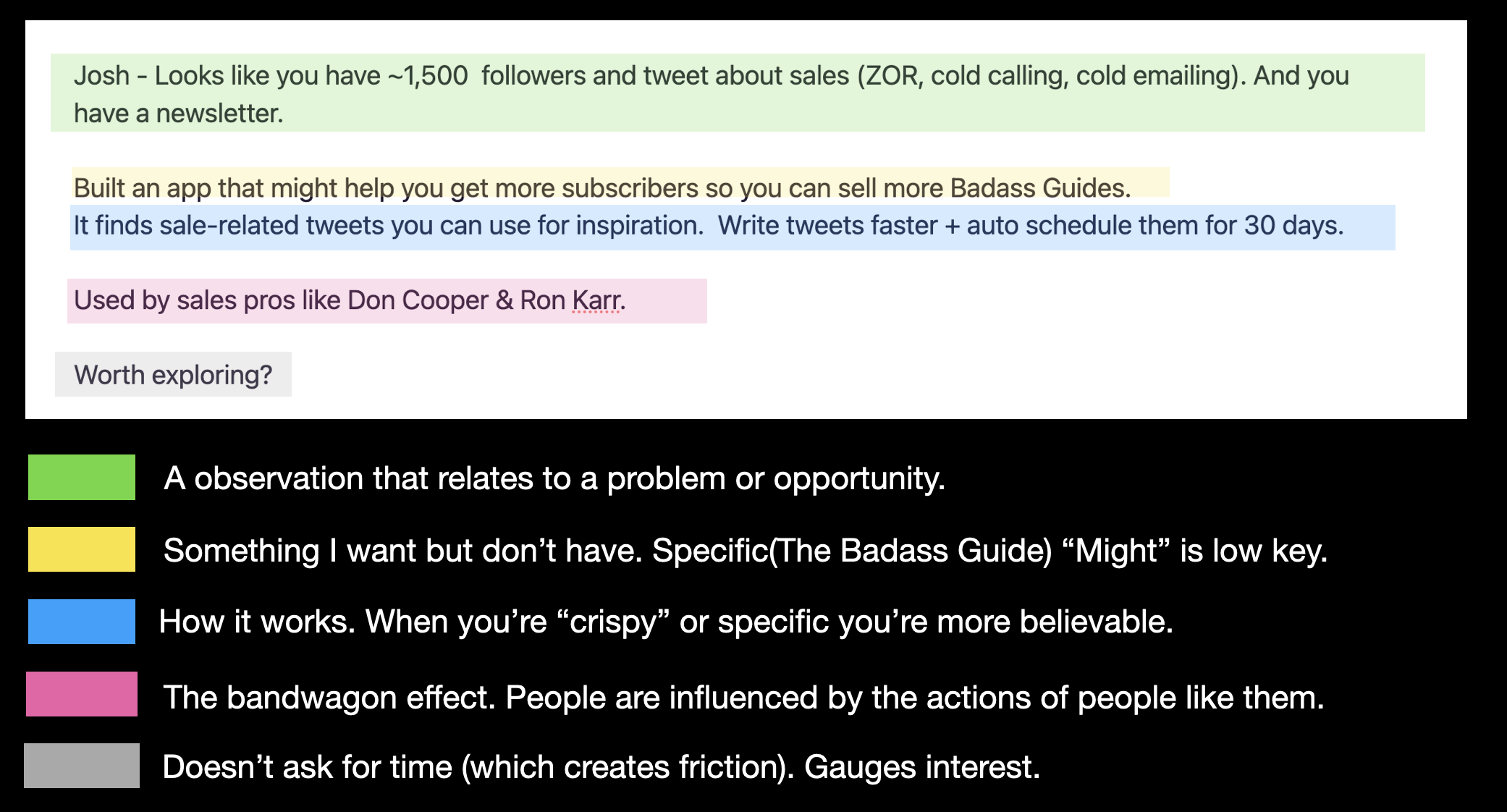
**THE BACKFIRE EFFECT**
If you tell someone to stop drinking, they drink even more.
Why?
People don't like people told what to do.
I’ll prove it to you.
When was the last time you changed your mind because someone told you to?
It’s called the backfire effect.
Autonomy is a basic human need.
The best way to persuade is to encourage people to persuade themselves.
How?
Ask, don't tell.
Telling:
“We showed XYZ company in your industry how to give reps visibility commission calculations using our solution.”
Asking:
“Are you using spreadsheets to calculate commissions?”
“We are.”
“Not sure if you're grappling with this, but I often hear that when reps can’t see the data and calculations behind their commissions, it can be difficult to understand. If you don't mind me asking how are you dealing with disputes today?”
The takeaway?
People are more persuaded by what they hear themselves say rather than what you say.
Buyers have the answers.
Sellers have the questions.
**CONTEXT MATTERS**
It’s shocking how many people send me cold emails that start like this:
“Hi Josh, I noticed you worked at Jellyvision from 2007 - 2018.”
“HI Josh, It looks like you’re the founder of Braun Training.”
That’s like saying, “Hi Josh, I noticed you breathe air.”
Saying something that’s obvious that didn’t need to be said falls flat.
Why?
There’s no context.
What does the number of years I spent working at Jellyvision have to do with a problem or opportunity?
The first question I ask myself when I read a cold email is:
“Why are you emailing me as opposed to someone else?”
Here’s an example of a cold email with context:
“_Pete - It looks like you have 9 SDRs, which suggests you’re sending cold emails._
_I spoke to an SDR out of NC who’s booking 15 meetings a month (mid-market) with Directors of Benefits via cold email. No cold calling._
_Since you folks sell into HR, I thought you might be open to learning how she’s doing it._"
Feel the difference?
The observation or context relates to the opportunity.
The switch?
No context → Context
**SORTING**
Here's how I close nearly 100% of inbound leads.
It takes guts.
I send this email before meeting with people.
“Hi James,
Nice meeting you, albeit virtually. I know you have your pick of sales trainers, so thanks for considering me.
So I don’t do you a disservice and waste your time, here are a few reasons why I might not be a fit for your SKO:
-I don’t sign NDAs or service agreements. I use a one page agreement.
-I charge X for an hour, Y for a half day and Z for a full day.
-Payment is required up front.
-I’m going to ask people to make live calls and send emails to real prospects.
-I require M&M’s but no brown ones :-)
We can discuss the details of the workshop of course, but first I wanted to find out if the above conditions work for you.”
This sorts out 7 out of 10 inquires.
I close nearly 100% of prospects I meet with.
The takeaway?,
Not a fit is a good outcome if determined early.
It’s a terrible outcome if determined late.
Knowing how to protect your time is a good skill to master.
The shift?
Selling -> Sorting
**MY 1 PAGE AGREEMENT**
This is my 1 page doc I send to new clients to clarify our agreement.
I will:
Run a 3 hour workshop covering:
-Why prospects are afraid of you.
-The 5 keys to lowering resistance.
-Selecting the best fit prospects.
-Clarifying your message.
-The spoken word (cold calling)
-The written word (cold emailing)
-A 60-minute post-workshop Zoom call to provide feedback on cold emails.
Payment is required prior to (date).
Here’s what's next:
You sign this document.
You depost in full via AHC wire, credit card, or check the amount of $X.
I show up on {date} at {location}.
This workshop will not help reps get better. Just like a 3 hour workout won’t make you fit. Practice over time with coaching will.
Manager buy-in, practice, and coaching is your job . Teaching, providing feedback, and answering questions is my job.
Looking forward to helping your team start more conversations with your ideal prospects.
X____________________________
Josh Braun
X____________________________
**GUIDING PRINCIPLES **
1. Prospects aren't against you; they are for themselves.
2. Failure teaches you as much as success.
3. Work where you're celebrated, not tolerated.
4. If prospects aren't interested, it means that you message isn’t interesting.
5. People don't resist change; they resist being changed.
6. It’s not your job to ask people into buying,. You don't create motivation; you align with it.
7. People don't buy because they understand you; they buy because you understand them.
8. Convincing is the lowest form of persuasion. To get and keep attention, shine a light on a meaningfully different idea related to a big expensive problem people don't know about.
9. Consistency beats intensity.
10. People are more persuaded by what they hear themselves say, not what you say.
11. Detach from the outcome. Tune out what you don't control. Tune in what you do.
12. Don't lie by omission. Be the arbiter of unbiased information. Tell the whole story, not part of the story.
13. Don't fight resistance. Join the resistance. Trying to change minds is a net negative every time.
14. Be patient. Nobody has it figured out; everyone is under construction.
15. If you can’t leave your job, you don’t have a job. The job has you.
**SALES JOB ADS**
If you’re reading ads for a sales job….
This is a red flag:
“You can make 500k a year.”
Here’s what’s more accurate:
“One of our 125 reps made 500k last year. This year, we cut her territory in half, so she'll make no more than $200k.”
“Most reps make $115k/yr and quit after 3 months.”
Be wary of emplyers that sell you the moon and the stars.
**NO WRESTLING**
Selling isn't like wrestling.
It's not your job to pin people down so you can convince them to buy.
Nobody wants to be convinced.
I'll prove it to you.
Have you ever changed your mind because someone told you to?
Do you think your prospects are different that you are?
Autonomy is a basic human need.
Selling is more akin to a smooth ballroom waltz.
You're leading without stepping on any toes.
You're asking neutral questions that shine a light on a potential problem or opportunity without leading people to a desired answer.
You're the arbiter of unbiased information.
You're enabling people to make decisions for themselves.
Some people will be open to talking and continuing the conversation.
Some people won't.
It's okay either way.
If someone want doesn't want to "dance" with you, find another partner
There are so many "dance partners.”
Without a partner, there is no dance.
Here's an example of what it looks like to lead a "dance."
This is for a product called ZBiotics, but you can easily apply the underlying psychology to your product or service.
**THOUGHTS ON VOICEMAIL **
Here’s the voicemail I left when I sold into HR:
_“Hi Lisa, My name is Josh Braun. We’ve never spoken, but we’re working with Melissa Davis, the Director of Benefits at Comcast, to reach employees who aren’t in front of a computer all day during open enrollment. Since you have deskless employees, I thought you might be open to learning more. I’ll send you an email so you can decide if it’s worth exploring.”_
This is for a benefits communication product but you can easily customize it for your product or service.
I found that when I used voicemail to promote my cold email, there was an uptick in response rate.
My cold email subject line was “voicemail.”
One big caveat.
The message matters.
You need to illuminate a meaningfully different idea related to a problem or opportunity your prospects don’t know about.
What do your prospects want but don't have?
**MY SALES PRINCIPLES**
Here are my 18 sales principles:
1. Prospects aren't against you; they are for themselves.
2. Failure teaches you as much as success.
3. Work where you're celebrated, not tolerated.
4. If prospects aren't interested, it means that you message isn’t interesting.
5. People don't resist change; they resist being changed.
6. It’s not your job to talk people buying.
7. People don't buy because they understand you; they buy because you understand them.
8. Convincing is the lowest form of persuasion. To get and keep attention, shine a light on a meaningfully different idea related to a big expensive problem people don't know about.
9. Consistency beats intensity.
10. People are more persuaded by what they hear themselves say, not what you say.
11. Detach from the outcome. The less you care about making the sale the more sales you make.
12. Don't lie by omission. Be the arbiter of unbiased information. Tell the whole story, not part of the story.
13. Don't fight resistance. Join the resistance. Trying to change minds is a net negative every time.
14. Be patient. Nobody has it figured out; everyone is under construction. You’re making progress even if it doesn’t feel that way.
15. If you can’t leave your job, you don’t have a job. The job has you.
16. Tune out what you don’t control. Tune in what you do.
17. In a world of similar products, trust is why people choose you over someone else.
18. Don’t interrupt people. Wait two beats after the other person is done talking before you talk. One Mississippi. Two Mississippi.
**MISCONCEPTIONS**
Here’s something I believed to be true until I was 42:
“You need to wait 30 minutes after eating before swimming to avoid cramps and potential drowning.”
This belief has been widely circulated, but there is no scientific evidence to support it.
Sources that debunk this myth include:
The American Red Cross: Their swimming and water safety guidelines do not include any recommendations about waiting to swim after eating.
Mayo Clinic: Experts at the Mayo Clinic have clarified that while it might feel uncomfortable to swim immediately after eating, it does not significantly increase the risk of drowning.
Why am I talking about this?
No matter what you sell, people are getting the job done when you reach out.
Educating customers about common misconceptions related to how they’re currently getting the job done loosens their grip on the status quo.
I’ll give you an example.
Several years ago, I got an email from Adam’s Polishes that said this:
“How do you know your wash mitt won’t scratch your car?”
That question made me subconsciously think, “Hmm, I’m not sure.”
Turns out, when you wash your car with a bucket and sponge, dirt and grit can get trapped in the sponge and scratch your car.
With a grit guard, dirt and grit settle to the bottom of the bucket and off your car, so you avoid scratching your paint.
Sold.
What terrible, not good, very bad thing happens if your prospects keep using their current solution?
**LET PEOPLE BE**
There are two ways to deal with a 4-year-old who doesn’t want to surf.
1. You can try to convince them to surf.
You can pick up the sword and fight.
The problem?
When people feel like you’re trying to convince them, their guard goes up. They dig their heels in even deeper.
Autonomy is a basic human need.
2. You can cover up your kid with a towel and go surfing.
You can drop the sword and let them be.
Which is what this father did :-)
Picking up the sword or dropping it.
It’s a choice.
Choose wisely.
**THE WAITING**
I don’t think we talk enough about the waiting.
The part when prospects aren’t ready to switch yet.
The problem isn’t intense or frequent enough.
They’re comfortable with the current way.
So to the salespeople in the waiting, don’t be disheartened.
You’ve done the hard part.
Now, be patient.
One day, the current way won't cut it.
They'll be ready to change.
In the meantime, stay top of mind.
Share information that makes prospects smarter about topics they care about. This book is an example.
Time doesn’t kill deals, it ripens them.
Last week, I won a deal that had been in the waiting for 17 months.
Selling is an exercise in patience.
Fruit doesn’t grow faster because it’s the end of the quarter.
**NO OVERCOMING OBJECTIONS**
I don’t overcome objections.
You tell me you’re in a meeting, I say:
“Okay, I’ll call you back.”
You say “I need to think about it,” I say:
“Okay. No rush.”
You say “Send me some information,” I say:
“What information would you like?”
I detach.
Why?
When you detach, you remove pressure.
Most salespeople create pressure.
Here’s what I’ve noticed:
When I surrender control, people come back for their reasons, not mine.
If they don’t come back, that’s okay.
I’m not interested in working with people I need to convince.
Selling without pushing, convincing, or begging.
The golden rule?
I sell like I want to be sold.
A father dropping the sword and letting his son be.
**ILLUMINATION QUESTIONS **
Can one question boost sales?
The answer is yes.
The question?
“Is your oil at the proper level?”
Texaco paid legendary copywriter Elmer Wheeler $5,000 in the 1930s for those seven words.
The result? The following week Texaco found themselves under 250,000 more hoods.
Wheeler was a master at making people scratch their head and think, “Hmm, I’m not sure. Better look into this.”
Why am I talking about this?
Asking a question makes prospects scratch their heads, compels them to find out more about what you are offering.
I call these illumination questions. You’re shining a light on a potential problem or opportuntiy without leading people to a desired answer.
Here are some examples:
"How can you tell when it’s time to retire?"
"How do you know your sponge won’t scratch your car?"
"Are you getting the lowest mortgage interest rate?"
"How are you accessing working capital without taking on debt or pledging assets?"
“Are you overpaying for SaaS subscriptions?”
“We know that Safari delete 3rd-party cookies every 7 days so you can't send cart or browse abandonment emails to half of your returning visitors. How have you been dealing with that?”
"In 2023, 353 million victims were exposed across 3,200 data breaches. Have your passwords and accounts been breached on the Dark Web?"
**UNSEATING THE COMPETITION**
I pay $85/month for lawn maintenance.
I’m getting the job done.
I’m making progress.
If you knock on my door and say, “Homeowners typically tell me they have weeds, bare spots or thinning grass. Do any of those issues resonate with you?” I’d say, “I’m good, thanks.”
If you say, “Do you have a budget?” I’d say, “No, my budget is frozen.”
If you say, “Is the timing right?” I’d say, “Call me next quarter.”
But that’s not what Luis did when he knocked on my door.
Here’s what Luis said throughout several conversations:
“These branches hanging over your roof are falling into your gutters, which can lead to mold, deterioration or leaks.”
“During a storm, these limbs can fall onto your home and damage your roof.”
“See these patchy brown spots of grass? That’s caused by low pressure around the valve head.”
“Here’s a landscape design that will make your home the envy of your neighborhood.”
“Here’s a lighting plan that not only adds beauty but makes your property more secure.”
Problem.
Problem.
Problem.
Guess what?
Timing “suddenly” became better.
I found the budget too.
7k for lights and landscaping.
$180/month for maintenance. 2X what I was paying.
The takeaway?
Luis didn’t ask about problems, he found them.
Don't be a problem asker. Be a problem finder.
**DEPOSITS VS WITHDRAWALS**
Whenever George rings my doorbell, he wants something.
"Josh, could you help me move a dresser?"
"Josh, can I borrow your drill?"
"Josh, my computer keeps freezing, can you take a look?"
Lately, when George rings the doorbell, I pretend I'm not home.
That's because George is overdrawn.
He's made too many withdrawals.
It’s the same with cold emails.
“We do X. Would it make sense to talk?”
“Do you have 15 minutes?”
“Any thoughts?”
Withdrawal.
Withdrawal.
Withdrawal.
When you're overdrawn, prospects duck and dodge you.
Instead of making a withdrawal, make four deposits first.
A deposit is useful information that helps your prospect do their job better. (Not a case study).
Here are a few examples of deposits:
Email 1“Lisa, here's a link to a fun slideshow called, 'What Zelda can Teach You About Writing Effective Cold Emails.'"
Email 2“Lisa, I saw you’re scaling your team. Here’s a link to an SDR calculator that helps you determine the right quota to set for each SDR based on your desired return.”
Email 3“Lisa, I analyzed 937 cold calls that booked meetings. Here’s a slideshow on what each of those calls has in common.”
No call to action. Just your name.
You'll start more way more conversations when you come from a place of giving, than you ever will by coming from a place of taking.
This book is an example of making a deposit. It's free. One day you might head over to https://joshbraun.com/shop/ and buy something. Or not. It's okay either way.
Are you overdrawn?
**WHAT IS LOVE?**
When I got Ruby, I expected lots of cuddles.
But she’s not a cuddler.
Today, she lay on my leg.
I wanted her to stay longer, but she went to another room shortly after.
It’s a good reminder.
Others, whether dogs or people, will behave according to their own nature—not necessarily in the way we hope or expect.
The goal isn’t to control behavior but to accept others as they are.
I think that’s what love is.
Ruby on leg.
**THREE STRIKES**
This is going to be a tough pill to swallow, so buckle up.
I don’t care how big the opportunity is; don’t chase prospects who have three strikes.
A prospect gets a strike if they cancel a meeting.
“Sorry, Josh, I need to cancel our meeting.”
Strike 1.
“Josh, can we push our meeting?”
Strike 2.
“Josh, I can’t meet today.”
Strike 3.
When a prospect gets three strikes, they’re out.
I send an email that says, “John, I might be misreading, but it seems like the timing is off for the project.”
Then I move on.
If you don’t hear back, it’s a gift. You now have more time to start conversations with people who are motivated to talk with you.
Don't play catch with people who keep all the balls.
It takes two people to make a sale.
Invest in prospects who invest in you.
**MY SALES MANTRA**
It's not my job to talk people into buying.
My job is to illuminate potential problems.
Some people will be interested in talking further. Others won't.
Doors opening and closing is the nature of sales.
My role is to be curious and listen without having expectations.
I embrace every aspect of the experience fully.
**THE KNOWLEDGE GAP**
Here's what an amateur salesperson sounds like:
Prospect: “I like the sofa but I can get it cheaper elsewhere.”
Seller: “What’s your budget? I might be able to offer you a discount because it's the end of the quarter.”
Here's what a pro salesperson sounds like:
Prospect: “I like the sofa but I can get it cheaper elsewhere.”
“Can I ask you question?”
“Sure.”
“One way companies cut costs is cushion density. Densities range from 1.5 which last 2-3 years before they sag to 2.5 with coils that last 10-15 years. What’s the density of the cushions in the other sofa?”
Prospect: “Hmm I'm not sure.”
(Detach)
Seller: “Does it make sense to hit the pause button so you can find out?”
Prospect: “Yes, let’s do that.”
Do you notice the difference?
Price is the last refuge when there's no meaningful difference.
The pro seller is shining a light on a gap in the prospect's knowledge.
I call this a knowledge gap.
Knowing how to illuminate a knowledge gap is a sales superpower.
**THE ASK**
I'm often asked:
“How do I follow up after a discovery call?”
You don't follow up.
You follow through.
How?
If there's alignment, ask for a micro-commitment after you've summarized the conversation. Like this:
“Would it be okay if I summarized what you told me?”
“You said X, Y, and Z.”
“Did I miss anything?”
Ask for a micro-commitment:
“Based on that, if you'd like we can schedule a demo over the next couple of weeks so you can see how this works?”
“No? Looks like I jumped the gun. Where would you like to go from here?”
Sales is like a smooth ballroom waltz. You're leading (the next step) without stepping on any toes.
Prospects decide if they want to dance with you.
Some will.
Some won't.
If prospects don't commit, it's not an opportunity. It's a conversation.
Without a partner, there is no dance.
It takes two people to make a sale.
**CALL ME BACK NEXT QUARTER**
The prospect says, “Can you call me back next quarter?”
How do you respond?
Most salespeople say something like this:
“What will be different in the next quarter?”
This reply can be interpreted as confrontational or challenging, putting the prospect on the defensive.
Why?
It assumes you understand the prospect's situation. You’re asking someone to justify their answer.
It presumes that there must be a significant change or improvement in the prospect's circumstances for them to reconsider the conversation, which may not be the case.
The way out?
Use a mirror or label to unlock more truth. (Chris Voss)
Here are some examples:
Mirroring:“Next quarter?”Repeating the 2-3 most important words with a slight uptone as if to say tell me more.
Labeling:“Sounds like you have other priorities you're focusing on.”“That’s not a problem. Seems like you have a bunch of things to wrap up before the end of the year.”
Labeling is verbalizing the underlying emotion behind what was said which elicits more information.
Mirroring and labeling unlock more truth.
Why does this matter?
No truth, no trust.
No trust, no transaction.
Don't fight the resistance.
Join the resistance.
Verbal aikido.
**WHY WORRY?**
I worried about getting good grades.
Not now.
All gone.
Bye-bye.
I worried about turning 50.
Not now.
All gone.
Bye-bye.
I worried about hitting quota.
Not now.
All gone.
Bye-bye.
The revelation?
There was never anything to grasp.
How heavy and dull I made my life by worrying.
Relax.
Just relax.
Recieve.
Be with what is occuring.
Do your best.
What comes comes.
**100% OPEN RATE**
How to get a 100% open rate on your cold outreach.
And never land in spam.
Send a letter in a FedEx envelope.
The psychology?
It doesn’t cost anything to send a cold email, so prospects don’t perceive it as valuable.
The inbox is a crowded channel.
FedEx is expensive compared to email so it feels more important or exclusive.
Yes, it’s a feeling.
I've printed my cold email and put it in a FedEx envelope.
Then I followed up with email:
“Subject line: July 14th FedEx”
**THREE WAYS TO LOSE YOUR BEST SALESPEOPLE**
1. Say you're going to change X and don't do it.
2. Congratulate them on achieving quota then increase quota by 15% while reducing their territory.
3. Increase their targets to pick up the slack for people not hitting targets.
**WHY ASSUMING BACKFIRES**
This story illustrates the problem with assuming in sales.
Matt and Mandy both lease apartments.
Mandy leases twice as many apartments as Matt.
Can you figure out why?
Here's Matt:
Prospect: "Does your condo have a pool?"
(Unbridled enthusiasm) Matt: "It does! It's the most beautiful and stylish pool in Boca Raton. The pool even has a 25-meter lap lane."
Prospect: "That's too bad. I have a two-year-old and don't want them near a pool." (Click.)
Here's Mandy
Prospect: "Does your condo have a pool?"
Mandy: "Sounds like a pool is important to you."
Prospect: "Actually, I have a two-year-old and don't want them near a pool."
Mandy: "That’s why I live here. I have a toddler too. Our pool has a child safety cover whenever a lifeguard isn't on duty. Additionally, there's a four-foot fence surrounding the pool with a door that can only open with a fob. If you'd like, I can show it to you."
Prospect: "That sounds safe. Can I swing by this afternoon?"
Letting go of assumptions.
**16 WAYS TO ADD FUEL TO CONVERSATIONS WITH PROSPECT**
16 ways to add fuel to discovery calls.
1. Be able to clearly and concisely explain to others what you do. Like this: “With Calendly, you paste a link into your email and schedule meetings without going back and forth to find the perfect time.”
2. Understand how people are currently getting the job done. “Would it be okay if I asked you some questions about how you wash your car?”
3. Ask a questions that make people think differently about their current solution. “Sometimes dirt and grit can settle to the bottom of the bucket and get trapped in your sponge, which can scratch your car. How are you making sure that doesn’t happen when you wash your car?”
4. Let your natural curious self come out when talking with prospects, not a sales robot with an agenda.
5. Seek the opinion of others. “Sounds like reps think the phone is a cactus. What’s your theory on why that is?”
6. Find ways to stay top of mind when people aren’t ready to buy. This post is an example.
7. Look for signs of confusion, boredom, or lack of interest and call it out. “Seems like I confused you.”
8. Prepare ahead of time for the conversation. Scan their LinkedIn profile. Read up on the product, why people switched, and the types of people they sell to.
9. Include others in the Zoom call that aren’t participating. “Mary, what’s your take on this?”
10. Keep up to date on industry trends.
11. Accept a person’s right to say no.
12. Show that you’re listening by actually listening. Summarize what you heard. “Bob, can I summarize what I heard?” People don’t buy because they understand you; they buy because you understand them.
13. Don’t forget your sense of humor.
14. Be curious about what interests other people.
15. Don’t make conversations feel like interrogations. Balance receiving with giving information.
**SELL ME THIS PEN**
Thoughts on "sell me this pen."
Jordon: “Sell me this pen.”
Josh: “Do you have a pen?”
Jordon: “I have several pens.”
Josh: “Do you need a new pen?”
Jordon: “No, I have a pen exactly like this one, but sell me this pen anyway.”
Josh: “I’m afraid I can’t do that.”
Jordon: “Why not?”
Josh: “I only sell pens to people who need a pen.”
The moral of the story?
It's not your job to talk people into buying pens.
Pens have no value without a problem.
**CRISPY COPY**
What’s the difference between these two cold emails?
Email A:
_“Hey Josh - We help sales training companies like yours drive leads. I wanted to learn how you handle lead generation at Braun Training and show you what we’re working on. Are you available for a brief call Thursday at 3 pm EST?”_
Email B:
_“Hey Josh — Looks like you run cold call workshops for tech teams with 12+ reps._
_Came across Pete Jones, Director of Business Development at [Company X]._
_He’s in the market for cold call training. They’ve hired 7 SDRs in the last 3 months and raised a $3.2M Series B in January. Imagine they want to get reps singing the same song on the phones._
_Found this intel through 6sense. I have 8 more tech sales teams in the same boat that seem to fit your ICP. Interested in going over them?”_
The difference?
Message A is generic.
Message B is specific, or “crispy.”
When you’re crispy, prospects secretly think, “You get me. What do you have?”
The secret to crispy copy?
Segment your list.
Niche down.
Go even further.
Now you’re speaking to everyone who does cold call workshops for teams with at least 12 reps.
It’s personal, not just personalized.
Most lists are too generic, which makes cold emails sound like Message A.
Segment your list - skyrocket response rates.
**LEADERBOARDS ARE AN ILLUSION**
They trick you into thinking you're getting better.
I'll prove it to you.
Imagine this scenario.
I sold more bananas than you did in Q1.
I'm above you on the leaderboard.
You sold more bananas than I did in Q2.
You're above me on the leaderboard.
Are you getting better as a banana seller?
Relative ranking can fluctuate without necessarily indicating real progress in your skills.
Leaderboards create a false impression that you're improving, simply because you rank higher or lower compared to others.
Compare your current performance with your past performance.
This self-comparison helps you focus on your own growth and development rather than how you stack up against others.
When you compare yourself to others you lose sight of yourself.
**TREES DON'T MOURN SEASONS**
There was this tree chilling in the forest.
One day the wind showed up.
“Hey, tree! I’m gonna blow you over!”
The tree didn’t even flinch.
It just went, “Cool. Do your thing.”
And it bent.
Not like a dramatic backflip or anything—just enough to say, “Nice try.”
Then fall came, and the tree’s leaves started dropping.
But did the tree freak out?
Did it go, “Oh no! My leaves! My style! What will the squirrels think?”
Nope.
The tree was all, “Whatever, I’ll grow new ones.”
And that’s where trees are brilliant.
They don’t fight the wind.
They don’t cling to dead leaves.
They know spring is coming, and they trust the process.
Sales works the same way.
Sometimes, a prospect ghosts you, and you feel like a tree losing its last leaf.
But guess what? New deals are out there, waiting to bloom.
So, be the tree.
Bend when things get tough.
Let go of bad deals.
And trust that if you keep your roots strong you’ll be back with fresh, green deals in no time.
Trees don't mourn seasons.
Trees in forest.
**SWAP NEXT FOR NOW**
When I started in sales, I couldn’t wait to land my first big deal.
And sure enough, I eventually closed Comcast.
Celebration, high-fives.
And then, I noticed something.
A day later, I was already thinking about the next big deal.
The next win.
The next milestone.
That initial excitement was quickly overshadowed by desire and pressure to keep going bigger.
In sales, it’s easy to chase the next target.
The next quarter’s goals.
Bigger accounts.
I think sometimes, we need to pause.
To take stock.
And recognize the wins we’ve already achieved.
You probably have what you once hoped for.
That sense of gratitude can refuel you more than any quota boost.
Stay ambitious.
But don’t forget to enjoy the journey.
Swap next for now.
**GAIN & LOSS**
This one stung.
I had a signed agreement for 65k.
Then was told they didn’t want to proceed.
I was irritated.
Here’s what went through my mind:
“What did I do wrong?”“What could I have done differently?”
I felt a loss of something I thought I had gained.
My happiness was attached to the sale.
It was “my sale.”
The problem is the word “my."
It's not "my" sale.
The sale doesn't belong to me.
The sale isn't owed to me.
Clinging to positive experiences or rejecting negative ones causes turmoil.
Gain and loss in sales and in life are inevitable.
In Buddhism, it’s one of the Eight Worldly Concerns.
Gain - Got a sale (Happy.)Loss - Lost a sale (Restless.)
Gain - Booked 5 meetings in a week. (Happy.)Loss - Booked 0 meetings the following week. (Anxious.)
Gain - Got a bonus. (Happy.)Loss - Lost money doing a home renovation project. (Upset.)
Here’s the reality of sales:
You can do everything right and still lose a sale.
Gain and loss are part of the same experience.
When you lose a sale, chances are you didn’t do anything wrong.You can’t lose a sale you never had.
Remember in sales and in life:
Anything can change at any time.(There’s power and confidence in accepting that.)
Training your mind to move in harmony with the nature of sales (and life) is the path to equanimity.
With practice, you pay less attention to the “gain” or “loss” and accept the ebb and flow of life.
Simple, but not easy :-)
**Watercolors**
I’m taking a watercolor class.
Here’s the thing about watercolor—it’s alive.
You dip your brush, touch it to the paper, and the water moves.
It drips, blends, spreads, does its own thing.
You can try to control it, but that’s a losing battle.
At first, I fought it.
I wanted perfect edges.
Crisp lines.
No mistakes.
Spoiler: watercolor doesn’t care what you want.
Then I started to lean in.
I let the water go where it wanted.
I stopped trying to force it and just… watched.
The more I let go, the more the painting came to life.
This is what watercolor teaches you:
You can’t control everything.
Watercolor is a masterclass in what the Stoics call the dichotomy of control.
There are things you can influence—like how you hold the brush or mix the colors.
And there are things you can’t—like how the water spreads.
Trying to control what you can’t is exhausting.
Letting it flow? That’s freeing.
And if all else fails, add more blue.
Blue fixes everything.
My first painting.
**THE POINT**
Tennis legend Roger Federer said that over the course of his career, he’s only won 54% of points.
In other words, the number 1 player in the world barely wins more than half the points.
It’s a good reminder not to dwell on every “point.”
Got hung up on?
It’s only a point.
Lost a sale?
It’s only a point.
Do your best playing each point.
When the point is in the past, it’s in the past.
Focusing on the present point without thinking about the next point or the previous point is the path to resilience and inner peace when selling.
FIND YOUR FIT
“Kim” wrote:
“I’ve been in sales for 22 years. I’m still an individual contributor making cold calls and sending cold emails. I’m miserable and think it shows up in my work. What’s your advice?”
If selling doesn’t feel good in your soul, you need to read this.
You can hustle harder.
Grind longer.
Detach from the outcome.
Make excuses about why things aren’t working out.
Here’s the truth.
When a job is right for you, it brings you fulfillment.
When a job is wrong for you, it brings you suffering.
What was once a fit may no longer be a fit. That’s okay. Everything changes.
Forcing a fit makes you feel split.
Find your fit.
**RESISTANCE IS FUTILE**
Have you ever noticed that the harder you push, the more resistance you get?
“I’m in a meeting. Can’t talk.”
“Yeah, that’s okay, I just need a second or so. I just wanted to find out if you – ”
“Don’t ever call me again!”
Statements like this subconsciously communicate that you're putting your best interest first.
You’re not validating what the other person is feeling. Even if they're not in a meeting, they don't want to talk with you.
The way out?
Don't fight resistance.
Join the resistance.
Like this:“Okay, I'll call you later.”
Then call back later. The prospect is more likely to take your call because you weren't tone-deaf.
Call people who don't tell you they’re in a meeting. That's most people.
Resistance is futile.
**COLD CALLING**
Here’s why prospects resist:
You’re gripping too tightly to something that’s meant to flow.
When you chase the outcome, the meeting, you create resistance.
Cold calling isn’t a rigid framework to cling to.
It’s more like a wave.
Moving.
Changing.
Your intent shapes what you say.
Prospects pick up not just on your words, but on your energy.
Your job is to be like a relaxed, chill surfer.
Balanced. Steady. Going with the current.
Here’s what that sounds like:
(Relaxed tone)
Prospect: Hello, this is Lisa.
Seller: Hey Lisa, this is Josh with TitanX, how are you doing?
Prospect: Okay, and you?
Seller: Can’t complain. I don’t know if I’m in the right spot. Maybe you could help me out for a moment?
Prospect: Sure.
Seller: Do you still oversee the SDR team over there?
Prospect: I do.
Seller: I’ve been hearing that most of the time when SDRs cold call, they run into voicemails or gatekeepers, even with direct dials. You’ve probably looked into services that let reps know who’s most likely to pick up before they dial.
👉 Here’s why this works: it’s the psychology of elicitation. When you make an observation instead of asking a direct question, you trigger a natural reflex in people to clarify or correct. It lowers their guard, gives them agency, and creates an open loop their brain wants to close. That’s why you often hear, “What do you mean?” or “We have.”
Prospect: What do you mean?
Seller: We’re a service in Tennessee that helps SDRs know who’s most likely to pick up so they spend more time in conversations instead of voicemails or dead numbers. Is that something you’d want to take a look at?
Prospect: Possibly. How does it work?
And here’s the punchline:
Surfers don’t fight the wave, they ride it.
Some rides last longer than others.
Good waves and wipeouts are part of the same experience.
The best sellers don’t force conversations.
They let them unfold.
**COLD EMAIL**
How to write cold emails that aren’t personalized but still get responses
Personalization is overrated.
Here’s an email you could send to every veterinarian. It’s personal, but not personalized:
⸻
Hey Dr. Pete,
Not sure about your clinic, but many vets say they’re losing 6–8% of their revenue YoY because pet owners buy similar products online or at pet superstores.
ACME & BETA clinics started private labeling. Same products with their clinic’s branding so clients can’t price-shop on Amazon or at a big-box store.
No setup or design fees, and you can start with as few as 12 units.
You’ve probably looked into this?
Lisa
_____
The Psychology
1. No assumptions in the opener
“Not sure about your clinic…” signals I’m not assuming anything about you. That lowers defenses and makes it safe to keep reading.
2. Relevance over personalization
It skips fake rapport and goes straight to a real problem most vets face: lost revenue to online or retail competitors.
3. Authority through social proof
Mentioning peer clinics (“ACME & BETA”) builds credibility and reduces perceived risk.
4. Objection-handling baked in
“No setup or design fees” and “low minimum order” neutralize cost and commitment concerns before they surface.
5. Ends with elicitation
“You’ve probably looked into this?” assumes the prospect is already in the know, which protects their ego. It’s a light nudge that invites correction or confirmation—much more natural than demanding a meeting.
This is the psychology of emails that get replies without personalization.
They’re relevant, low-pressure, and easy to say yes or no to.
**QUESTIONS CAN BACKFIRE**
The fastest way to make a prospect lie?
Ask them a question.
Why?
Because prospects know the question isn’t neutral.
They sense it’s being asked to gather ammunition to sell them something, so their shield goes up.
Take this question:
“What are you currently doing to protect your kids from bumping their head into a table?”
On the surface, it’s just a question.
But underneath, the prospect hears the subtext:
You’re setting me up.
Whatever I say is going to be used against me in the sales pitch.
People instinctively guard their answers.
They give half-truths, deflect, or shut down altogether.
That’s the Zone of Resistance.
Now compare that to a statement framed as an observation:
“When kids start walking, crawling turns into bumping into everything. I’d imagine you’re using table corner protectors.”
Now the other person leans in:
“Wait, what’s that?”
Or, “We are.”
That’s elicitation.
Either way, you’ve unlocked more truth.
The truth might be that there’s no problem to solve.
That’s great if you find out early. Not so great if you find out late.
Why?
Your solution has no value without a problem.
More Examples:
To a TSA agent at the airport:
“This has to be the busiest time of year.”
→ “Actually, the days just before Christmas and the first few days of January are way busier.”
At a dinner party:
Not “How much was your watch?” (Too blunt.)
Instead try: “I read online that Rolex watches are six figures these days.”
→ “Not this one. It was 10k. It’s a Submariner.”
Chatting with a neighbor:
“I heard this neighborhood has tons of block parties.”
→ “Actually, no. But the park is amazing.”
Prospect: “We’re ramping up the outbound team.”
→ “Wow, that has to be stressful. Probably keeps you up at night.”
On a cold call:
“Saw a stat online that cold call connect rates hover around 2–4%. Even with direct dials it’s mostly voicemail and gatekeepers. Yours are probably well above that.”
Instead of:
“Are you happy with your dialer?”
Try:
“I read that AI dialers are making connect rates skyrocket.”
“Your reps are probably crushing quota.”
If it’s true, they’ll tell you what’s working.
If it’s not, they’ll explain why.
No interrogation.
No trap.
Just an observation.
Instead of prying information out, you’re drawing it out naturally.
You’re not demanding answers, you’re creating conditions where people want to share.
Ask and they resist.
Observe and they reveal.
**DISCIPLINE**
I’ve never heard anyone talk about this in sales.
The role discipline plays in your success.
Here’s an example:
Before you leave work, you make a list of 40 people to call tomorrow.
And then tomorrow, you call them.
You do that every day.
That’s discipline.
Discipline isn’t about grinding harder.
It’s not about motivation or inspiration.
It’s about making choices today that serve you tomorrow.
It’s your present self helping your future self.
Your present self wants to scroll, procrastinate, and avoid rejection.
Your future self wants more conversations with prospects.
Discipline is choosing for your future self.
That’s what builds consistency.
That’s what compounds over time.
That’s what separates amateurs from pros.
Because when tomorrow comes, your future self looks back and says:
“Thanks. Thanks for getting this list together so I can hit the ground running. Thanks for not leaving me to dig through the CRM when I’m already tired.”
That’s the quiet power of discipline.
It’s not punishment. It’s a gift your present self gives your future self.
Text from my wife today:
“I might buy these…
They look darker in the last pic because of the lighting.
They’re on floor model sale, half off!”
If you’re married, you already know.
This isn’t a question.
It’s not a debate.
It’s a gentle heads up that a delivery truck is now part of our weekend plans.
Salespeople, take notes.
This is how people buy.
They justify.
They rationalize.
They explain the lighting.
Then they tell you about the discount.
By the time they’re texting you, the decision’s already made.
You didn’t close them.
They closed themselves.
Your job?
Spark the idea.
Illuminate the cost of inaction.
Make space for it to grow.
Then step aside.
Because when people talk themselves into something?
They don’t return it.
**EVERYTHING IS IMPERMANENT**
no matter how good you are at sales
things won't always go
the way you want them to go
you might lose
a sale you were
certain you'd win
you might lose
the confidence you never imagined
you'd surrender
you might lose
your smile
and feel sad
but before you know it
a new person comes along who buys
and a wiser, more confident you appears
It’s okay to feel sad
even the sky cries sometimes
and shines the next day
everything
is
impermanent
**BEST COLD CALL**
This is the best cold call I ever got and why.
**WHY BRAINS RESIST THE PITCH**
Why prospecting is so challenging.
Brains don’t want new things.
They want familiar things that already get the job done.
Familiar feels safe.
Change feels risky.
Risky means:
“I could lose my job.”
“I could lose status inside the company.”
“I could look stupid.”
That resistance isn’t just about sales.
It’s human.
It’s why parents who see the world as scary pass that belief on to their kids.
It’s why kids who were abused sometimes end up with people who abuse them.
The brain clings to what it knows, even if it hurts.
So what’s the way out?
Not by convincing.
Not by changing minds.
Changing minds sounds like this:
“We’ve developed a breakthrough that increased cold call connect rates by 30–40%. The reason for my call is to share this breakthrough with you. Do you have your calendar handy?”
That screams risk.
Instead, help prospects feel safe.
Like this:
“I saw a stat online that connect rates hover around 2–4%. Even with direct dials it’s mostly voicemail and gatekeepers. That probably hasn’t been the case for you guys.”
Feel the difference?
That’s elicitation.
It lowers defenses because it’s not pushing an agenda.
It’s not trying to change their mind.
It’s simply observing their world.
And when people feel safe, they open up.
People don’t resist change. They resist being changed.
**1.6 MILLION**
I heard someone giving advice on how they made $1.6M in tech sales by age 30.
It was well meaning.
They wanted to help.
To show others what’s possible.
But the message intentionally or not was:“Do what I did, and you can make this kind of money too.”
I’ve made $1M in tech sales.
And I’ve given advice too.
But here’s what I don’t say enough:I got lucky.
Right product.
Right timing.
Great marketing.
A boss who gave me equity and it happened to hit.
An industry with momentum.
A comp plan that hadn’t been “realigned” yet.
Sure, I had skills.
But so do you.
Had you been in my role, with those same conditions, you probably would’ve crushed it too.
Maybe even more.
Flip it around?
Put me in your job, with your challenges and comp plan?
I might be struggling.
Sales isn’t a perfect meritocracy.
It’s messy.
It’s tilted.
And yeah, luck plays a bigger role than we like to admit.
This isn’t a knock on anyone who’s found success.
Celebrate it.
Share it.
Just don’t forget the part we can’t control.
Sometimes, “Here’s how I made $1.6M in sales by 30”is really just:“Here’s how things happened to line up for me.”
And that’s okay too.
**EYE TO EYE**
When I first started selling, I was intimidated by the C-suite.
I put them on a pedestal.
So I’d show up from a one-down position.
Cautious, careful not to say the wrong thing.
But then I realized: the C-suite is made up of people.
They watch Netflix.
They laugh at dumb jokes.
They worry about the same things we all do.
And because they’re in their own orbit, they don’t always have visibility into every opportunity or blind spot across the organization.
That’s where my job came in.
To approach them as an equal.
Not one up. Not one down.
Here’s what approaching the C-suite like an equal sounds like:
“I read a stat online that around 37% of SaaS apps end up underutilized or unused. Totally normal with fast growth, different teams grab tools, and not all of them stick long term. I’d imagine you already have a way of catching unused or redundant tools before they pile up.”
Then shut your mouth.
The psychology?
Normalization. You frame the problem as universal: “Happens with fast growth…” This lowers defensiveness because it’s not about their failure, it’s about how the system works for everyone.
Assumes competence. “I’d imagine you already have a way…” protects their status. You’re not implying they’ve dropped the ball. You’re signaling respect.
Invites correction or confirmation. If they do have a system, they’ll explain it. If they don’t, they’ll often admit it. Either way, you get useful intel without pushback.
Silence. The final move stop talking. Elicitation works because the brain hates open loops. People feel a natural pull to close them, which means they start talking.
Not one up.
Not one down.
Just eye to eye.
**BE YOU**
Beth is a successful AE who is unapologetically herself.
She’s a little goofy.
Laughs at her own jokes.
She claps when someone explains something clearly.
Waves at dogs on Zoom calls.
Does this little shoulder dance when a prospect says something interesting.
Says things like,
“Okay, this might be a weird question that I probably shouldn’t ask…”
and then asks it anyway.
Admits, “I’m slightly biased here.”
And it’s so refreshing.
Because most of us try to become who we think we’re supposed to be.
More serious.
More “professional.”
But here’s what I’ve noticed.
When you try to be someone you’re not, people feel it.
There’s a stiffness.
A script.
A performance.
When you’re fully yourself, there’s ease.
Why?
You come across as more real.
More authentic.
More relatable.
The irony?
The thing you’re tempted to hide
is often the thing that makes people trust you.
And why does trust matter?
In a world of similar products, trust is why people choose you.
You don’t need a persona.
You need to be a person.
Be you.
**GRUDGES**
For a long time, I carried a grudge against my mom.
When my dad died, he left her money.
She went through it.
Cars.
Parties.
Renovations.
When it was gone, she came to me.
I was tight.
Judgy.
Angry.
I thought, “How could you be so irresponsible?”
I helped… but barely.
Enough to pay the bills.
No warmth.
No softness.
Part of me wanted her to feel it.
Like I needed to punish her.
Later, I learned more of her story.
She lost her brother at 14 (suicide).
Had an abusive dad.
Lost her mom at 21 (cancer).
Lost my dad at 48 (cancer).
Got addicted to prescribed pain meds (Fiorinal).
That's a lot of loss, pain and suffering.
Doesn't mean I suddenly agreed with everything she did.
But it changed how I saw her.
Pain leaks out in weird ways.
Sometimes it looks like bad decisions.
Sometimes it looks like spending money you don't have.
Sometimes it's drinking.
Or pills.
The grudge wasn't hurting her.
It was hurting me.
I was the one replaying it.
Carrying it.
Feeding it.
My mom wasn't some irresponsible character in my story.
She was a human.
Doing the best she could
with the wiring and wounds she had.
My mom was a continuation of things that happened in her past that she didn't choose.
Just like me.
Just like you.
Just like everyone.
Letting go didn't excuse anything.
But it did swap anger with compassion and love.
In that moment I realized:
Compassion and love can't co-exist with anger and fear.
That shift felt like dropping a heavy weight.
So the next time you're holding a grudge remember:
We're all first-timers at life.
Some of us are just doing it with heavier baggage.
**THE KNOWLEDGE GAP**
Most salespeople, especially early in their careers, operate from a defensive position like a bear protecting its cubs.
A prospect says, ‘I like the sofa, but I can get it cheaper elsewhere,’ and the amateur scrambles for something to protect the deal.
Usually, that ‘something’ is a discount: ‘What’s your budget? Maybe I can work something out.’”
On the surface, it seems practical.
You’ve addressed the objection.
You’ve lowered the barrier.
But in reality, you’ve already lost.
Why?
Because you’ve conceded that the only difference worth comparing is price.
And once the frame is price, someone will always be cheaper.
Discounting doesn’t solve the problem, it confirms it.
Price becomes the last refuge when the prospect sees no meaningful difference between what you offer and what they already have.
**The Pro’s Move**
Now let’s watch a professional in the same situation:
Prospect: “I like the sofa, but I can get it cheaper elsewhere.”
Seller: “Can I ask you a question?”
Prospect: “Sure.”
Seller: “One way companies cut costs is by cushion density. Densities range from 1.5, which last two to three years before they sag, to 2.5 with coils that last 10–15 years. What’s the density of the cushions in the other sofa?”
Prospect: “Hmm, I’m not sure.”
Seller: “Does it make sense to hit pause so you can find out?”
That tiny pivot changes everything.
Instead of defending price, the professional seller reframes the conversation around something the buyer didn’t know to consider: cushion density.
Suddenly, it’s not just about “sofa A” vs. “sofa B.” It’s about lifespan, durability, and long-term cost.
**Why It Works: The Psychology of Poking the Bear**
This technique works because it taps into a powerful force in human behavior: the knowledge gap effect.
Psychologist George Loewenstein coined the term curiosity gap to describe what happens when people realize there’s a gap between what they know and what they could know. That gap creates tension an itch the mind feels compelled to scratch.
The pro salesperson exploits this mechanism by poking the bear, bringing up a potential problem the buyer hasn’t thought about.
By asking about cushion density, they expose the buyer’s blind spot. Once the buyer realizes they don’t know the answer, they want to resolve it.
They lean in, not because you pushed, but because their own psychology pulls them forward.
There’s another layer here: autonomy. Autonomy is a basic human need, just like food and safety.
People resist when they feel controlled.
They lean in when they feel they’re making their own choices.
That’s why the best way to persuade is not to argue, it’s to let people persuade themselves.
By poking the bear and then stepping back, you create the space for that self-persuasion to happen.
**The Detachment Layer**
But there’s another subtlety: detachment.
The seller doesn’t jump in with, “Well, our sofa uses 2.5 density so it’s clearly better.” That would feel like a pitch. Instead, they say, “Does it make sense to hit pause so you can find out?”
That detachment matters. It signals: “I’m not here to force you. I’m here to help you make the right decision for you.”
When sellers let go of needing to win, buyers feel free to choose—and paradoxically, that freedom often leads them closer to saying yes.
**The Real Estate Example**
The same psychology shows up when homeowners push on commission.
Homeowner: “Another agent said they’d list my home for one point less.”
An amateur might respond with a defensive discount: “I can match that.” But the pro pokes the bear:
“With a reduced commission, the pool of agents eager to bring buyers through your door can shrink. How are you thinking about handling that trade-off?”
“Part of the commission goes toward attracting buyer’s agents to your property. If that piece is reduced, it can impact exposure. How are you making sure your home still gets full visibility?”
“Sometimes that 1% savings looks great on paper, but if it means your home doesn’t get as much attention or as many strong offers, it could end up costing you much more than you save. How are you weighing that trade-off?”
Notice the structure: the agent doesn’t argue. They don’t defend. They don’t beg. They poke the bear, shine a light on a blind spot, and step back—allowing the homeowner to do the persuading in their own head.
**Beyond Sofas and Homes: Other Industries**
Knowledge gaps aren’t limited to furniture and real estate. They’re everywhere:
Software (SaaS): A VP of Sales says their reps are using a dialer to cold call. You lean back and poke the bear:
“Not sure about you folks, but I’ve been hearing that most of the time when SDRs use dialers, they run into voicemails, no answers, or gatekeepers, even with cell phone data. How have you been dealing with that?”
Healthcare: A hospital buyer says, “Another supplier quoted 20% less.” The rep pokes the bear: “Do you know if their devices have FDA 510(k) clearance for pediatric use?” Suddenly, the decision isn’t about price, it’s about compliance and risk.
Hiring/HR: “Many hiring managers tell me their ATS is overflowing with AI-generated résumés, making it harder to spot real talent. How are you keeping yours from getting clogged?”
Payments: “When a chargeback comes in, do you spend time gathering evidence even if Toast usually denies it, or have you decided the effort isn’t worth it?”
In every market, amateurs accept price as the frame. Professionals poke the bear to expose the unseen dimensions that actually drive value.
**Amateur vs. Pro: A Psychological Breakdown**
Amateur seller mindset:Objection = threat
Responds defensively
Narrows the frame to price
Creates downward pressure on margin
Professional seller mindset: Objection = Understanding
Responds by poking the bear
Expands the frame to knowledge
**The Poke the Bear Framework**
To master this, you need a repeatable structure. Here’s a fill-in-the-blank framework you can use to craft your own poke-the-bear questions:
Step 1: State a common challenge you’ve observed.
“Many [job title/role] tell me…”
“Sometimes when [situation happens]…”
“One way [vendors/competitors] cut costs is…”
Step 2: Point to the hidden cost, risk, or blind spot.
“…it leads to [hidden consequence].”
“…that usually means [problem they don’t see].”
Step 3: Ask how they’re handling it.
“How are you thinking about handling that trade-off?”
“How are you making sure [negative outcome] doesn’t happen?”
“How have you been dealing with that?”
**Examples with the Framework Applied:**
“Many hiring managers tell me their ATS is overflowing with AI-generated résumés, which makes it harder to spot real talent. How are you keeping yours from getting clogged?”
“One way companies cut costs is cushion density. Densities range from 1.5 to 2.5. What’s the density of the cushions in the sofa you’re comparing?”
“With a reduced commission, the pool of agents eager to bring buyers through your door can shrink. How are you planning to handle that trade-off?”
“Sometimes that 1% savings on commission looks great on paper, but it can mean fewer showings and weaker offers. How are you weighing that trade-off?”
“When a chargeback comes in, do you spend time gathering evidence even if Toast usually denies it, or have you decided the effort isn’t worth it?”
"Coffee machines have lots of little spots where bacteria like E. coli, staph, and strep can grow. The spout, water tank, K-cup slot, and drip tray, especially. How do you usually keep yours clean?”
"Read a stat online that around 37% of SaaS apps end up underutilized or unused. Totally normal with fast growth, different teams grab tools, and not all of them stick long term. How are you currently catching unused or redundant tools before they pile up?”
**Exercises: Building Your Poke-the-Bear Muscle**
Map the Obvious vs. the Hidden. Write down the three most common objections you hear. For each, list the obvious comparison the buyer is making (usually price, speed, or features). Then, brainstorm three hidden dimensions they’re probably overlooking.
Craft Poke-the-Bear Questions. Use the framework above to turn each hidden dimension into a poke-the-bear question.
Test in the Field.
On your next sales call, pick one poke-the-bear question. Use it. Then stop talking. Let the silence do the work. Notice how often prospects move themselves forward without you pushing.
**The Takeaway**
Sales isn’t about clever comebacks or discounting your way past objections.
It’s about illuminating potential problems people can’t see.
When you poke the bear, exposing hidden costs, risks, or inefficiencies, you transform from a amateur to a pro people trust.
Price becomes less important. Trust becomes the currency.
Ironically, the less you push to win the deal, the more deals you win.
Selling isn’t about closing, it’s about opening.
And nothing opens better than letting people persuade themselves by discovering a problem they didn’t know they didn’t know.
Ditch the pitch.
Poke the bear.
**HOW TO STAY UNBOTHERED **
1. **Detach from the outcome**. Expect nothing. Focus on your actions, not the results.
2. **Stay grounded**. A lost deal doesn’t define you; a won deal doesn’t elevate you.
3. **Listen aggressively**. People will tell you what they need if you give them the space.
4. **Speak with purpose**. Say only what’s essential—words are tools, not filler.
5. **Move in harmony with the nature of sales**. Ghosting, rejections, wins, and territory changes are all part of the experience. Accept them as the way.
6. **Know when to walk away**. Not a fit is a terrific outcome if determined early.
7. **Be humbly curious.** Humility keeps your ego in check, reminding you there’s always more to learn. Curiosity pushes you to ask: What could I have done differently? What did I do well? What did this experience teach me about the prospect, the process, or myself?
8. **Ask for feedback when you don’t get a sale**. Learning sharpens your skills.
9. **Be grateful**. Millions of people would consider it a blessing to trade places with you even on your worst day.
10. **Trust the impermanence of things**. Everything will be okay if you’re okay with everything.
11. **Nobody has it figured out**. No matter how confident or successful someone seems, everyone is navigating uncertainty. Behind every polished sales pitch, closed deal, or LinkedIn post celebrating a win, there’s trial, error, and doubt. Recognizing this frees you from the pressure of perfection. It’s okay not to have all the answers—nobody does.
12. **You didn’t do anything wrong.** You can do everything right and still miss quota (aka a guess). Treat yourself like you’d treat your best friend. Imagine each day has four quarters:
• Q1 Morning
• Q2 Midday
• Q3 Afternoon
• Q4 Evening
If you mess up in Q2, kick rocks. Vent to friends who support you. Take a walk. Then try again in Q3. There’s always another quarter.
13. **Luck plays a huge part in success**. No matter how hard you work, success is never entirely in your control. Timing, connections, and circumstances often play a significant role. Recognizing luck’s influence doesn’t diminish your effort—it offers perspective.
**SHAMELESS PLUG**
If you'd like to continue learning from me, here are some products that might help.
[Tongue Tied Objection Flashcards](https://jbraun.gumroad.com/l/objectionflashcards). Objection on the front, what to say on the back. Includes how-to-say-it audio files, digital + physical flashcards, video lectures, and real cold calls.
[Poke the Bear Cold Calling](https://courses.joshbraun.com/p/poke). Talking with people who have very little desire to talk with you.
[The Badass B2B Growth Guide](https://courses.joshbraun.com/p/badass-b2b-growth-guide). This guide is filled to the brim with tactics that stack the odds in your favor for getting people’s attention and keeping it.
[The Discovery Call Course](https://courses.joshbraun.com/p/discovery). How to elegantly lead an initial conversation with a potential customer. The gentle art of understanding instead of convincing.